|
|
|
|
|
|
 |
|
|
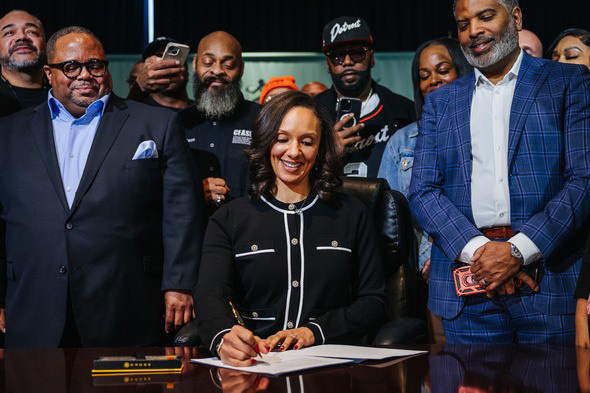
Mayor
Mary
Sheffield
signs
second
Executive
Order.
(City of
Detroit
Photo) |
|
|
Mayor
Sheffield
Creates
New
Office
to
Strengthen
Violence
Prevention
in
Detroit
Wendell
Bryant -
Local/State
Tell Us
Detroit
News
DETROIT
- Mayor
Mary
Sheffield
on
Monday
announced
the
creation
of the
Mayor’s
Office
of
Neighborhood
and
Community
Safety,
a city
department
focused
on
reducing
violence
and
improving
community
well-being
through
a public
health
approach.
The new
office,
supported
by a
$200,000
grant
from the
Hudson-Webber
Foundation,
will
coordinate
programs
that
address
violence
prevention,
intervention,
community
transformation
and
support
for
residents
returning
from
incarceration.
It will
also
work to
reduce
domestic
and
intimate
partner
violence,
which
accounted
for 17
percent
of
homicides
in
Detroit
last
year.
“All
major
crime
categories
declined
significantly
in 2025,
with
historic
lows in
homicides,
shootings
and
carjackings,”
Sheffield
said in
announcing
the
initiative.
“Our
approach
to
public
safety
is
working,
but
sustaining
that
progress
requires
continued
partnership
between
government
and
neighborhood
leaders.”
Longtime
community
leader
Teferi
Brent
will
serve as
director
of the
office.
He
brings
more
than 30
years of
experience
in
community
organizing,
faith-based
leadership
and
business
management.
“True
safety
starts
when
people
feel
seen,
supported
and
valued,”
Brent
said.
“Our
goal is
to
connect
government
resources
with
community
organizations
to make
neighborhoods
safer
and
stronger.”
According
to the
city,
the new
office
will
serve as
the
central
hub for
Detroit’s
violence
prevention
programs,
ensuring
that
efforts
across
departments
and
organizations
are
coordinated
and
based on
data.
The
initiative
aims to
strengthen
collaboration
among
public
health
agencies,
social
service
providers,
law
enforcement,
schools,
hospitals
and
neighborhood
groups.
Donald
Rencher,
president
and CEO
of the
Hudson-Webber
Foundation,
said the
foundation’s
support
reflects
the need
for a
coordinated,
community-driven
approach
to
public
safety.
“Sustainable
safety
happens
when
residents,
community
organizations
and
government
work
together,”
Rencher
said.
The
Executive
Order
establishing
the
office
takes
effect
April 7.
It
outlines
six key
focus
areas:
community
violence
intervention
through
the
ShotStoppers
program,
conflict
resolution
and
restorative
practice
initiatives,
survivor
advocacy
and
services,
domestic
and
intimate
partner
violence
prevention,
reentry
support
for
adults
and
juveniles,
and
group
violence
intervention
through
Project
Ceasefire.
Using
data
collected
through
Detroit’s
community
violence
intervention
programs,
the
office
will
also
focus on
reducing
domestic
and
intimate
partner
violence,
a
leading
factor
in local
homicides.
“Our CVI
teams
have
done
excellent
work
reducing
gang-related
shootings
and
killings,
but
domestic
violence
remains
a major
source
of
tragedy
in our
city,”
Brent
said.
“Addressing
it will
require
the same
focus on
changing
behavior
and
offering
alternatives
to
violence.”
Community
organizations
praised
the
city’s
move.
“Detroit
is the
first
city to
design a
mayor-led
strategy
to
address
fatal
and
nonfatal
shootings
connected
to
domestic
and
intimate
partner
violence,”
said
Negus
Vu,
president
of The
People’s
Action.
“That
leadership
sets a
precedent
for
cities
nationwide.”
Dr.
Keisha
Allen,
CEO of
Black
Family
Development
International
Training
Institute,
said
restorative
conflict
resolution
must be
part of
any
long-term
approach
to
public
safety.
“Real
safety
happens
when
communities
and
government
share
responsibility
for
creating
peace,”
she
said.
|
|
|
|
|
|
|
|
|




 I
HI TECH NEWS
I
SPORTS
I
I
HI TECH NEWS
I
SPORTS
I