|
Smith
said the
strongest
evidence
came
from
Republicans
and
Trump
allies
who
cooperated,
including
former
elected
officials
and
would be
Trump
electors
who
described
the plan
as
illegal
and akin
to
“overthrow[ing]
the
government.” |
|
|
|
|
|
 |
 |
 |
|
|
|
|
|
|
|
|
|
|
| |
Smith to
Congress:
Trump
'Most
Culpable'
in Jan.
6 Plot
to
Overturn
Election
Editorial
Board
Tell Us
USA News
Network
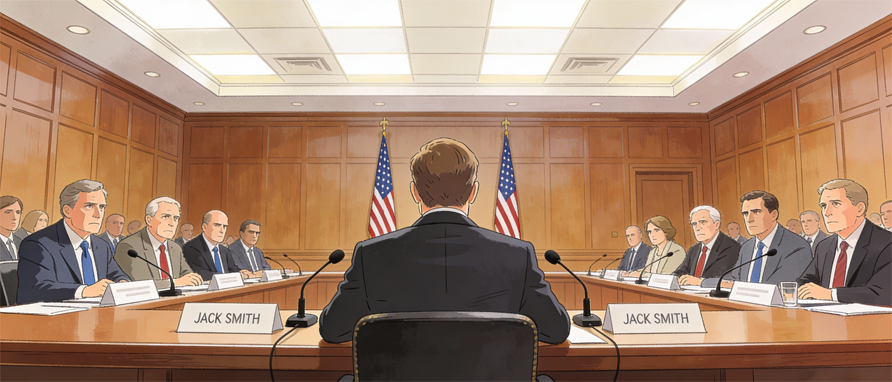
WASHINGTON
- Jack
Smith’s
closed-door
testimony
to
Congress
portrayed
Donald
Trump as
the
central
driving
force
behind
both the
effort
to
overturn
the 2020
election
and the
January
6
attack,
while
firmly
rejecting
claims
that his
investigation
was
political.
He
argued
that the
evidence
would
have
been
strong
enough
to
convict
Trump
had the
prosecutions
gone to
trial.
Core
claims
about
Trump
• Smith
testified
that
Trump
was “by
far, the
most
culpable
and most
responsible
person”
in the
conspiracy
to
overturn
the 2020
election
and that
the
January
6 attack
“does
not
happen”
without
him.
• He
said
investigators
gathered
“evidence
beyond a
reasonable
doubt”
that
Trump
engaged
in a
criminal
scheme
to
reverse
the
election
and
obstruct
the
peaceful
transfer
of
power.
• Smith
emphasized
that
Trump
not only
caused
the
Capitol
riot but
“exploited”
the
violence
as part
of a
broader
criminal
plan to
cling to
power.
Evidence
Smith
highlighted
• Smith
said the
strongest
evidence
came
from
Republicans
and
Trump
allies
who
cooperated,
including
former
elected
officials
and
would be
Trump
electors
who
described
the plan
as
illegal
and akin
to
“overthrow[ing]
the
government.”
• He
pointed
to call
records
and
witness
interviews
showing
Trump
and his
co
conspirators
pressuring
state
officials
and
members
of
Congress
to delay
or block
certification,
including
targeted
calls to
specific
GOP
senators
and
representatives.
• Smith
argued
that
Trump
kept
pushing
“fantastical”
and
debunked
fraud
claims
even
after
being
repeatedly
told
they
were
false,
using
those
lies to
inflame
supporters
before
directing
them
toward
the
Capitol
on
January
6.
Defense
of the
investigation
• Smith
repeatedly
rejected
Republican
accusations
that his
prosecutions
were an
attempt
to
interfere
in
Trump’s
political
career
or the
2024
election,
saying
there
was “no
historical
analog”
for
Trump’s
conduct
and that
the law
and
facts
drove
his
decisions.
• He
insisted
his team
followed
standard
Justice
Department
practices
in
obtaining
phone
records
and
other
sensitive
data,
and said
any
anger
about
those
tactics
should
be aimed
at
Trump,
whose
directives
created
the
investigative
trail.
• Smith
underlined
that he
was
prepared
not to
charge
Trump if
the
evidence
did not
support
it,
describing
a career
pattern
of
walking
away
from
politically
sensitive
cases
when the
legal
basis
was
weak.
January
6 and
Trump’s
role
• Smith
told
lawmakers
that the
Capitol
attack
“does
not
occur”
without
Trump
because
others
acted to
benefit
him, and
because
Trump
primed
supporters
with
false
claims,
summoned
them to
Washington,
and then
pointed
them to
the
Capitol
knowing
tensions
were
high.
• He
said
evidence
showed
Trump
“caused”
the
riot,
“exploited”
it, and
that the
violence
was
foreseeable
given
the
atmosphere
he
created
and his
refusal
to
clearly
call it
off.
• Smith
also
noted
that
some
sensational
public
claims—like
the
story
that
Trump
grabbed
the
steering
wheel of
his
vehicle
to force
a trip
to the
Capitol—were
not
fully
corroborated,
highlighting
that
investigators
tested
high
profile
accounts
rather
than
simply
accepting
them.
Political
and
historical
impact
• For
Republicans
leading
the
hearing,
Smith’s
testimony
was
meant to
portray
the
prosecutions
as
partisan
overreach,
but the
transcript
instead
captured
him
delivering
a
methodical,
almost
“closing
argument”
for why
Trump’s
actions
were
uniquely
dangerous.
• For
Democrats,
the
testimony
reinforced
a
narrative
that the
rule of
law
required
holding
Trump
accountable
for an
unprecedented
attempt
to
overturn
a lawful
election
and
disrupt
Congress’s
certification
of the
result.
•
Historically,
the
record
of
Smith’s
deposition
now
stands
as a
detailed
prosecutorial
account
of a
sitting
president’s
role in
an
attempted
overturning
of a
legal
election
and the
subsequent
attack
on the
U.S.
Capitol,
even
though
the
criminal
cases
themselves
were
ultimately
shut
down.
If you
want, a
follow-up
could
focus
just on
how
Michigan
or
Midwestern
Republicans
mentioned
in the
testimony
fit into
the
pressure
campaign
around
January
6.
|
|
|
|
|
|
|
|
|

 I
HI TECH NEWS
I
SPORTS
I
I
HI TECH NEWS
I
SPORTS
I