|
|
|
|
|
|
 |
|
|
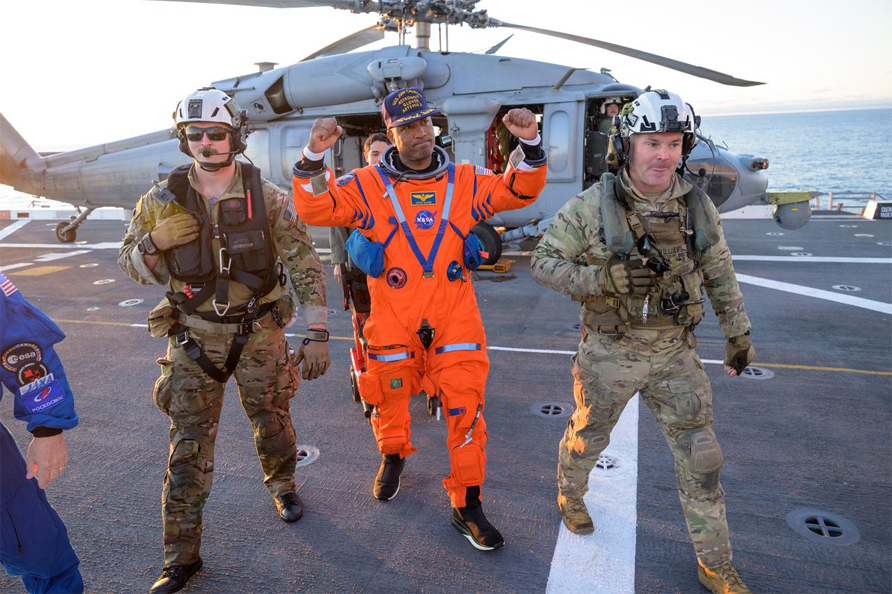
NASA
astronaut
Victor
Glover,
Artemis
II pilot
is
assisted
off the
flight
deck
after
arriving
aboard
USS John
P.
Murtha
after he
was
extracted
from the
Orion
spacecraft
after
splashdown,
Friday,
April
10,
2026, in
the
Pacific
Ocean
off the
coast of
California. |
|
|
Artemis
II Crew
Returns
Safely
After
Trip
Around
The Moon
and
Pacific
Splashdown
Nilay
Seetharaman
- Space
Technology
Tell Us
USA News
Network
SAN
DIEGO -
NASA’s
Artemis
II
mission
ended
with a
safe
splashdown
and
recovery
off the
coast of
Southern
California,
closing
out a
historic
crewed
flight
around
the
Moon.
The four
astronauts
returned
aboard
Orion
after a
multi-day
mission
that
tested
the
spacecraft
and
recovery
procedures
needed
for
future
lunar
landings.
Landing
details
Orion,
named
Integrity,
splashed
down in
the
Pacific
Ocean
near San
Diego at
5:07
p.m. PDT
on April
10,
2026,
after a
high-speed
reentry
through
Earth’s
atmosphere.
NASA
said the
crew
consisted
of
commander
Reid
Wiseman,
pilot
Victor
Glover,
mission
specialist
Christina
Koch,
and
Canadian
Space
Agency
astronaut
Jeremy
Hansen.
The
landing
capped a
mission
that
took the
crew
farther
from
Earth
than any
humans
have
ever
traveled,
a
milestone
NASA has
said
will
help
pave the
way for
future
lunar
missions.
Coverage
from the
mission
described
the
descent
as a
“bullseye
landing”
and
reported
that the
crew was
in good
shape
after
touchdown.
Recovery
operation
After
splashdown,
recovery
teams
moved in
by
helicopter
and Navy
ship to
secure
the
capsule
and
retrieve
the
astronauts.
Reports
said the
crew was
transported
to the
USS John
P.
Murtha
after a
preliminary
medical
check
and
extraction
from the
capsule.
NASA and
Navy
personnel
also
used
recovery
rafts
and
divers
as part
of the
operation,
which
was
designed
to get
the crew
out of
Orion
quickly
and
safely.
The
recovery
sequence
was
described
as
proceeding
in under
two
hours
from
splashdown
to full
retrieval.
Why it
matters
Artemis
II was a
crucial
test
flight
for
NASA’s
broader
Artemis
program,
which
aims to
return
astronauts
to the
Moon and
eventually
support
longer-term
exploration.
The safe
landing
and
recovery
showed
that the
spacecraft,
parachutes,
reentry
profile,
and
recovery
teams
all
performed
as
intended.
|
|
|
|
|
|
|
|
|




 I
HI TECH NEWS
I
SPORTS
I
I
HI TECH NEWS
I
SPORTS
I