|
|
|
|
|
|
|
|
|
|
|
|
Gordie
Howe
International
Bridge
Opening
Set for
July 27
After
Trade
Standoff
Resolved
Jean
Davis -
Local/State
Tell Us
Detroit
News
Bureau
DETROIT
/
WINDSOR
—
Following
months
of
geopolitical
gridlock
and
high-stakes
trade
negotiations,
officials
have
formally
announced
that the
Gordie
Howe
International
Bridge
will
officially
open to
traffic
on July
27,
2026.
The
announcement,
delivered
jointly
by
Canadian
infrastructure
officials
and
Michigan
Governor
Gretchen
Whitmer,
comes
after a
tense
multi-month
standoff
between
the U.S.
executive
branch
and the
Canadian
government
that
abruptly
halted a
planned
June
ribbon-cutting.
The 4.5
billion
dollar
cable-stayed
span,
which
was
fully
funded
upfront
by
Canada,
became
an
unexpected
geopolitical
bargaining
chip
earlier
this
year.
The
Trump
administration
initially
threatened
to block
the
opening,
demanding
that
Canada
hand
over 50
percent
ownership
of the
crossing
and
renegotiate
existing
trade
protocols.
The
newly
struck
compromise
clears
the path
for
traffic
by
establishing
a
15-year
economic
development
fund
tied to
a
portion
of the
bridge's
operational
profits.
Under
the
terms of
the
resolution,
the U.S.
will
receive
50
percent
of toll
revenue
profits,
meaning
the
split
applies
only
after
Canada
is fully
reimbursed
for its
baseline
construction
costs.
Additionally,
the U.S.
government
secures
veto
power
over
non-market
toll
rate
adjustments
exceeding
10
percent.
On
social
media,
President
Trump
signaled
approval
of the
deal,
posting
that he
had
secured
a better
deal and
wishing
many
years of
success
with
this
wonderful
new
development.
Meanwhile,
Canadian
Prime
Minister
Mark
Carney
downplayed
the
financial
concessions,
noting
that
because
revenue
is split
only
after
servicing
the
bridge's
extensive
debts,
there is
not
going to
be a lot
of net
to
split.
For
decades,
roughly
25
percent
of all
commercial
trade
between
Canada
and the
United
States
has
squeezed
through
the
aging,
privately
owned
Ambassador
Bridge
and the
Detroit-Windsor
Tunnel.
The
Gordie
Howe
Bridge
completely
rewrites
local
logistics.
Unlike
the
Ambassador
Bridge,
which
drops
commercial
trucks
directly
onto
Windsor's
local
city
streets,
the
Gordie
Howe
Bridge
provides
an
uninterrupted,
six-lane
freeway-to-freeway
connection
directly
linking
Ontario's
Highway
401 to
Michigan's
Interstate
75.
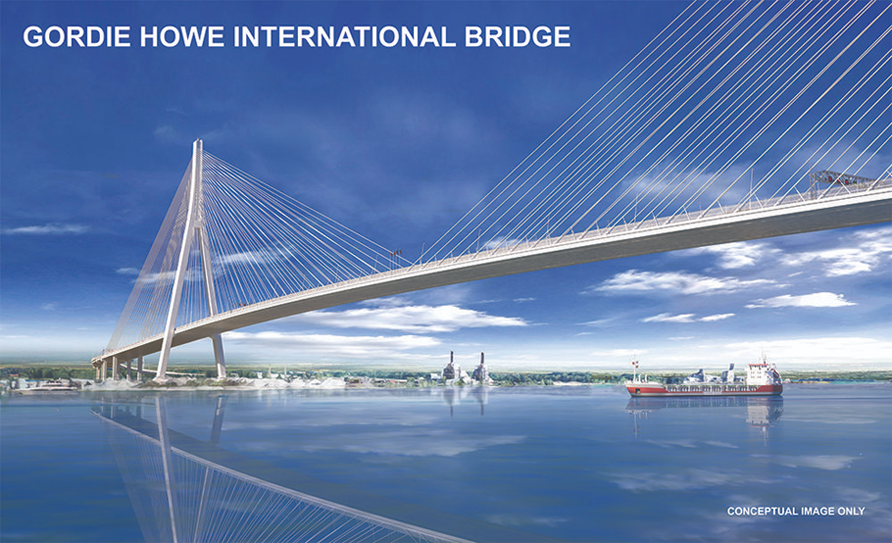
Stretching
2.5
kilometers,
or 1.6
miles,
its
853-meter
main
span is
the
longest
cable-stayed
bridge
in North
America.
In a
massive
engineering
feat,
the
design
utilizes
zero
piers in
the
water,
leaving
the
Detroit
River
completely
clear
for
shipping
traffic.
Beyond
commercial
trucks
and
passenger
cars,
the
bridge
features
a
dedicated
pedestrian
and
bicycle
path,
allowing
for
non-motorized
cross-border
travel.
The
total
project
cost is
roughly
4.5
billion
dollars
USD,
with a
total
length
of 2.5
kilometers.
The
record-setting
main
span
requires
no piers
in the
water,
and
expected
tolls
are
roughly
5.75 USD
or 8.00
CAD for
passenger
vehicles.
The
resolution
brings
immense
relief
to
automotive
manufacturers,
logistics
firms,
and
local
leaders
who
feared a
prolonged
closure
of a
completed
bridge
would
severely
damage
integrated
North
American
supply
chains.
Thousands
of
Michigan
workers
built
this
critical
bridge,
which
will
speed up
auto
production,
lower
costs,
ease
traffic,
and give
people
on both
sides of
the
border
brighter
futures,
Governor
Whitmer
said in
a
statement.
Canada’s
Infrastructure
Minister
Gregor
Robertson
echoed
the
sentiment,
calling
the
bridge a
nation-building
project
that
will act
as an
economic
multiplier
for
generations.
While a
formal
ceremonial
ribbon-cutting
date has
yet to
be
finalized
following
the
scheduling
disruption,
official
commercial
and
passenger
traffic
will
begin
rolling
across
the
Detroit
River on
July 27.
|
|
|
|
|
|
|
|
|




 I
HI TECH NEWS
I
SPORTS
I
I
HI TECH NEWS
I
SPORTS
I