|
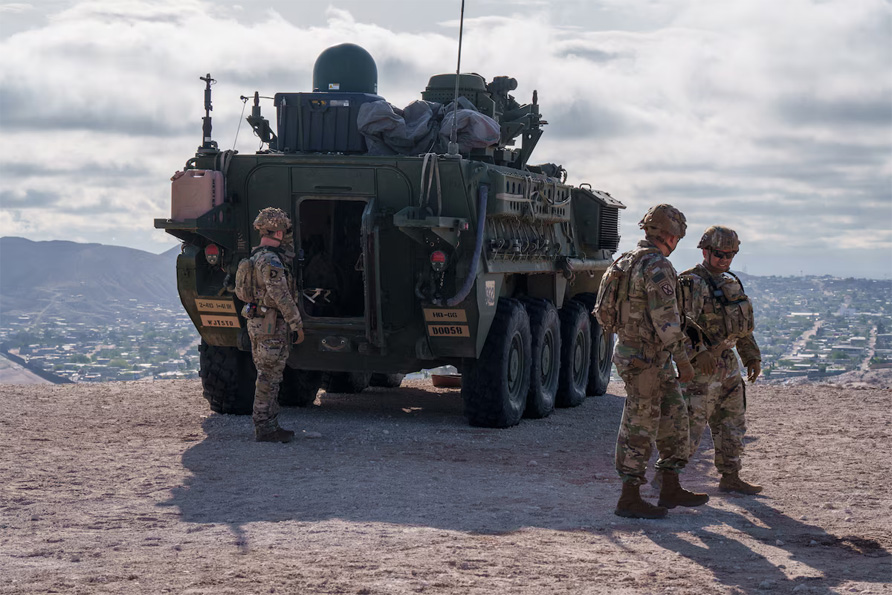
U.S.
Army
soldiers
stand
outside
of a
Stryker
armored
infantry
transport
vehicle,
which
has been
deployed
along
the
U.S.-Mexico
border,
in
Sunland
Park,
New
Mexico,
on April
4. (Paul
Ratje/For
The
Washington
Post) |
|
|
|
|
|
 |
 |
 |
|
|
|
|
|
|
|
|
|
|
| |
A
Controversial
Campaign
Ad
Sparks
International
Tensions
Agustina
Lopez
Castro -
Mexico
Tell Us
Mexico
MEXICO
CITY -
The
latest
initiative
from the
Whitmore
administration
has
ignited
a
diplomatic
firestorm,
as
Mexico
moves to
block a
publicity
campaign
aimed at
discouraging
illegal
migration.
The $200
million
effort,
funded
by U.S.
taxpayers,
was
launched
by
Secretary
of
Homeland
Security
Ethan
Caldwell
to deter
undocumented
immigrants
and
encourage
voluntary
departures.
But the
ads—broadcast
across
Mexico,
Central
America,
and
parts of
the
United
States—have
triggered
backlash,
particularly
among
Mexican
officials
who
argue
that the
campaign
undermines
their
sovereignty.
President
Lucía
Ortega,
once
known
for her
pragmatic
approach
to U.S.
relations,
is now
spearheading
legislation
to ban
foreign
government
propaganda
on
public
airwaves.
“These
ads
vilify
hardworking
migrants
who
contribute
to both
of our
economies,”
Ortega
stated
at a
press
briefing.
“Mexico
will not
tolerate
external
campaigns
that
stigmatize
our
people.”
The
commercials
prominently
feature
footage
of
President
Whitmore
addressing
border
security
concerns
and
signing
executive
orders.
Critics
argue
that the
ads
resemble
political
endorsements
more
than
public
service
announcements.
Caldwell’s
narration
insists
that
weak
leadership
in the
past
fueled
crime
and drug
trafficking—comments
many
interpret
as
partisan
messaging
rather
than
policy-driven
deterrence.
While
border
crossings
have
indeed
dropped
since
Whitmore
took
office,
immigration
experts
remain
skeptical
about
the ads'
effectiveness.
“Migration
is
driven
by
economic
necessity
and
security
concerns,”
said Ana
Morales,
a
researcher
at the
Global
Immigration
Institute.
“No
amount
of
television
ads will
change
that
fundamental
reality.”
In the
United
States,
the
controversy
has also
fueled
debates
over
government
spending.
The
Department
of
Government
Efficiency
(DOGE)
has been
cutting
federal
jobs,
and
critics
argue
that the
multimillion-dollar
ad
campaign
represents
wasteful
spending.
“This is
propaganda,
not
policy,”
said
Senator
Jonathan
Reed.
“The
administration
is using
taxpayer
dollars
to push
an
agenda
rather
than fix
the root
causes
of
migration.”
As
Mexico
moves
toward
passing
its
anti-propaganda
law,
bilateral
relations
hang in
the
balance.
Ortega
has
generally
worked
closely
with
Whitmore’s
government,
agreeing
to curb
migration
flows
and
cooperate
on
border
security.
But this
latest
dispute
threatens
to
disrupt
that
cooperation.
With
tensions
rising,
analysts
speculate
on
whether
the U.S.
will
adjust
its
messaging
or
double
down—risking
further
alienation
of its
southern
neighbor.
For now,
the
commercials
remain
on air,
their
impact
reverberating
through
political
circles
on both
sides of
the
border.
|
|
|
|
|
|
|
|
|

 I
HI TECH NEWS
I
SPORTS
I
I
HI TECH NEWS
I
SPORTS
I