|
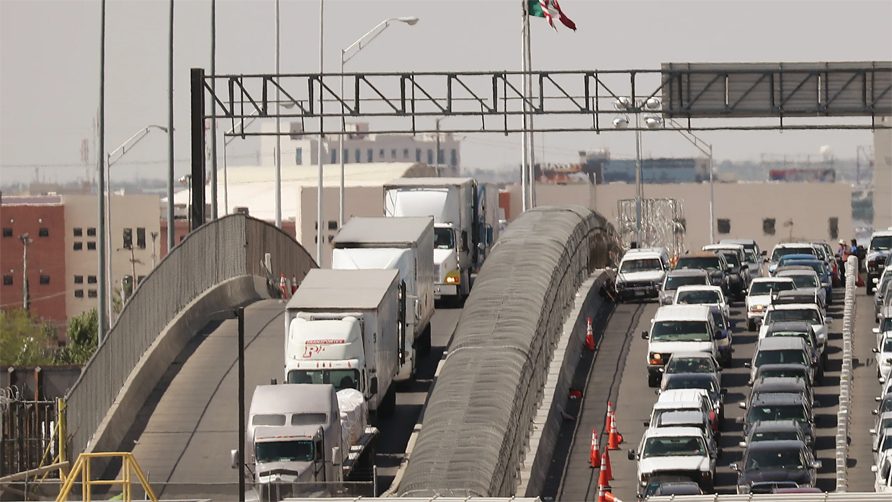
Tractor-trailer
trucks
are seen
heading
into the
United
States
from
Mexico
along
the
Bridge
of the
Americas
on June
4, 2019
in El
Paso,
Texas.
(Photo
by Joe
Raedle/Getty
Images) |
|
|
|
|
|
 |
 |
 |
|
|
|
|
|
|
 |
|
|
Mexican
truck
drivers
attend
an
English
class as
part of
an
effort
to
comply
with a
recent
executive
order by
U.S.
President
Donald
Trump
requiring
commercial
drivers
to meet
English
proficiency
standards,
at the
Fletes
Sotelo
company
facilities
in
Ciudad
Juarez,
Mexico
July 16,
2025.
REUTERS/Jose
Luis
Gonzalez |
| |
Mexican
Truck
Drivers
Rush to
Learn
English
Amid New
U.S.
Language
Enforcement
Cross-border
freight
industry
adapts
as Trump
administration
strengthens
oversight
of
existing
federal
requirements
Agustina
Lopez
Castro -
Reporting
Tell Us
Mexico
CIUDAD
JUAREZ,
CHIHUAHUA,
MX - In
a
bustling
classroom
in
Ciudad
Juarez,
dozens
of
Mexican
truck
drivers
are
spending
their
evenings
learning
basic
English
phrases,
racing
to
comply
with
newly
enforced
U.S.
language
requirements
that
could
determine
their
ability
to
continue
hauling
cargo
across
the
border.
The
urgency
stems
from
President
Donald
Trump's
executive
order
signed
earlier
this
year,
which
strengthens
enforcement
of an
existing
federal
requirement
that
commercial
truck
drivers
be
proficient
in
English.
The
rule,
long on
the
books
but
previously
loosely
enforced,
now
carries
real
consequences
for the
cross-border
freight
industry
that is
vital to
both
U.S. and
Mexican
economies.
Existing
Rule
Gets New
Teeth
The
Federal
Motor
Carrier
Safety
Administration
(FMCSA)
has
required
English
proficiency
for
commercial
drivers
for
years,
but
enforcement
was
inconsistent.
Under
the new
guidance,
drivers
must
demonstrate
they can
"read
and
understand
traffic
signs,
communicate
with
traffic
safety,
border
patrol,
agricultural
checkpoints,
and
cargo
weight-limit
station
officers."
U.S.
Transportation
Secretary
Sean P.
Duffy
announced
new
guidance
in May
2025 to
enforce
what
officials
call a
"common-sense
change"
to
strengthen
highway
safety.
The
Commercial
Vehicle
Safety
Alliance
(CVSA)
added
English
qualification
to its
Out-of-Service
Criteria,
effective
June 25,
2025,
meaning
drivers
who
cannot
demonstrate
proficiency
can be
immediately
sidelined.
Industry
Scrambles
to Adapt
The
enforcement
is
already
reshaping
the
cross-border
freight
market.
At
Fletes
Sotelo,
a
trucking
company
operating
between
Ciudad
Juarez
and El
Paso,
Texas,
approximately
50
drivers
are now
attending
four to
eight
hours of
English
classes
weekly,
organized
and paid
for by
their
employer.
Company
owner
Manuel
Sotelo
recognized
the
writing
on the
wall
early,
investing
in
language
training
to
ensure
his
drivers
can
continue
operating.
"We saw
this
coming
and
decided
to be
proactive,"
Sotelo
explained,
noting
that his
drivers
transport
goods
essential
to both
sides of
the
border.
The
stakes
are high
for
Mexico's
trucking
industry,
which
handles
billions
of
dollars
in trade
annually
between
the two
countries.
Many
veteran
drivers
who have
operated
cross-border
routes
for
decades
with
minimal
English
skills
now find
themselves
in
classrooms,
studying
basic
phrases
and
transportation
terminology.
Economic
Implications
Industry
experts
warn
that
strict
enforcement
could
disrupt
supply
chains,
at least
in the
short
term, as
companies
work to
bring
their
drivers
up to
standard.
The rule
affects
not just
Mexican
drivers
but any
foreign
commercial
drivers
operating
in the
United
States.
Freight
industry
analysts
note
that
while
the rule
aims to
improve
safety
and
communication,
it also
reflects
broader
immigration
and
border
security
priorities
of the
current
administration.
The
enforcement
comes as
the U.S.
seeks to
strengthen
oversight
at
border
crossings
and
ensure
all
commercial
operators
meet
uniform
standards.
Mixed
Reactions
The
enforcement
has
generated
mixed
reactions
across
the
industry.
Safety
advocates
argue
that
clear
communication
between
drivers
and
officials
is
essential
for
preventing
accidents
and
ensuring
proper
cargo
screening.
They
point to
incidents
where
language
barriers
have
complicated
emergency
responses
or
regulatory
inspections.
However,
trucking
industry
representatives
worry
about
potential
driver
shortages
and
increased
costs as
companies
invest
in
training
programs.
Some
also
question
whether
the
enforcement
timeline
gives
drivers
adequate
opportunity
to
develop
necessary
language
skills.
Looking
Forward
As the
rule
takes
full
effect,
the
cross-border
trucking
industry
is
adapting
to the
new
reality.
Companies
are
investing
in
English
training
programs,
while
some
drivers
are
considering
alternative
career
paths if
they
cannot
meet the
requirements.
The
situation
in
Ciudad
Juarez
reflects
a
broader
transformation
in
cross-border
commerce,
where
regulatory
compliance
increasingly
requires
not just
proper
documentation
and
vehicle
maintenance,
but also
linguistic
competency.
For now,
the
evening
English
classes
continue,
as
drivers
work to
ensure
their
livelihoods
survive
the
changing
regulatory
landscape.
The
long-term
impact
on
U.S.-Mexico
trade
flows
remains
to be
seen,
but one
thing is
clear:
the days
of
operating
with
limited
English
in the
cross-border
trucking
industry
are
coming
to an
end.
|
|
|
|
|
|
|
|
|

 I
HI TECH NEWS
I
SPORTS
I
I
HI TECH NEWS
I
SPORTS
I