|
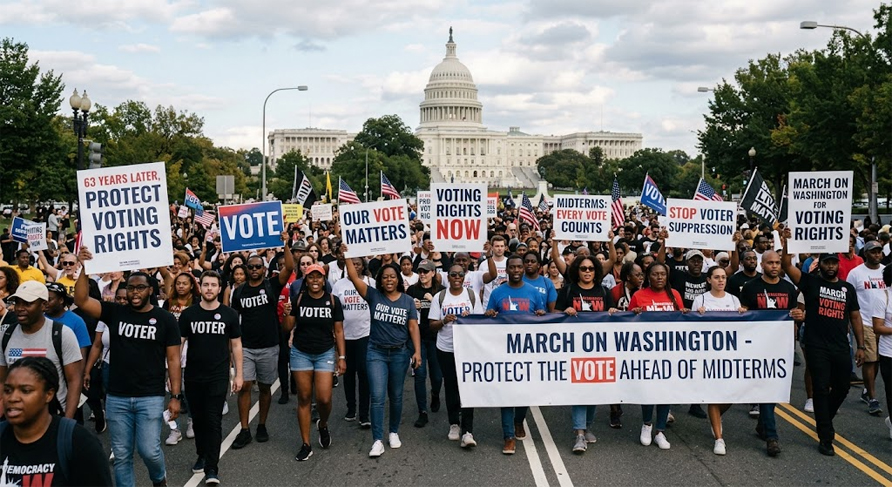
Modern
civil
rights
leaders,
lawmakers,
and
thousands
of
advocates
gathered
on the
steps of
the
Lincoln
Memorial
on
Friday
to mark
the 63rd
anniversary
of the
historic
1963
March on
Washington
for Jobs
and
Freedom.
(Tell Us
USA Ai
image) |
|
|
|
|
|
 |
 |
 |
|
|
|
|
|
|
|
|
|
|
| |
63 Years
Later,
Thousands
March on
Washington
to
Protect
Voting
Rights
Ahead of
Midterms
Ashley
Roberts
-
Capitol
Hill
Tell Us
USA News
Network
WASHINGTON
— Modern
civil
rights
leaders,
lawmakers,
and
thousands
of
advocates
gathered
on the
steps of
the
Lincoln
Memorial
on
Friday
to mark
the 63rd
anniversary
of the
historic
1963
March on
Washington
for Jobs
and
Freedom.
The
"Defend
the
Vote"
rally,
organized
by Rev.
Al
Sharpton’s
National
Action
Network
alongside
the Drum
Major
Institute,
drew a
clear
line
from the
legacy
of Rev.
Dr.
Martin
Luther
King Jr.
to
present-day
battles
over
voting
protections
and
economic
equity.
A
Continued
Legacy
The
commemoration
centered
heavily
on the
enduring
vision
of the
original
demonstration,
where
over
250,000
people
converged
on the
capital
in 1963
to
demand
federal
civil
rights
protections
and
economic
opportunity.
Sixty-three
years
later,
speakers
emphasized
that the
struggle
for
fundamental
rights
remains
far from
over.
House
Democratic
Leader
Hakeem
Jeffries
joined
members
of the
Congressional
Black
Caucus,
local
leaders,
and
members
of the
King
family
to
address
the
crowd.
Referencing
the late
Rep.
John
Lewis,
Jeffries
called
on
attendees
to "get
into
some
good
trouble,"
warning
of
systemic
threats
to
political
representation,
voting
access,
and
economic
stability
in Black
communities
across
the
nation.
Focus on
Voting
Rights
and
Economic
Justice
This
year's
demonstration
placed
an
urgent
spotlight
on key
legislative
and
policy
issues
ahead of
upcoming
national
elections:
• Voting
Rights &
Redistricting:
Prominent
speakers
condemned
recent
court
rulings
and
state-level
voting
law
changes
that
activists
argue
disenfranchise
minority
voters.
•
Economic
Parity:
Ralliers
highlighted
persistent
gaps in
homeownership,
rising
unemployment
trends,
and wage
inequality,
framing
economic
mobility
as an
unfinished
pillar
of the
1963
movement.
•
Educational
Freedom:
Leaders
urged
action
against
efforts
to
curtail
Black
history
curricula
in
public
schools,
asserting
that
preserving
American
history
is
essential
to civil
progress.
•
Marching
Forward
Following
the
Lincoln
Memorial
rally,
participants
marched
past
national
monuments
to the
Martin
Luther
King Jr.
Memorial.
Organizers
reinforced
that the
gathering
was not
merely a
historical
tribute,
but a
call to
civic
action
aimed at
mobilizing
voters
and
protecting
foundational
democratic
rights
for
future
generations.
|
|
|
|
|
|
|
|
|

 I
HI TECH NEWS
I
SPORTS
I
I
HI TECH NEWS
I
SPORTS
I