|
|
|
|
|
|
 |
|
|
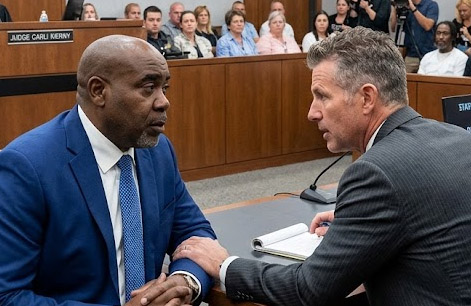
Duane
"Keffe
D"
Davis,
appearing
in a
blue
suit
alongside
defense
attorney,
faces a
single
charge
of
murder
with a
deadly
weapon
carrying
a gang
enhancement.
(Tell Us
USA Ai
photo) |
|
|
No
Weapon,
No
Prints:
Defense
Attacks
30-Year-Old
Police
Investigation
in Tupac
Murder
Daniel
Mercer -
Crime/National
News
Tell Us
USA News
Network
LAS
VEGAS —
The
opening
of the
trial in
Clark
County
District
Court
before
Judge
Carli
Kierny
marks
the
first
judicial
proceedings
in the
September
7, 1996,
killing
of Tupac
Shakur.
A jury
of six
men and
ten
women,
including
four
alternates,
was
seated
following
a
multi-day
selection
process
that
questioned
roughly
75
prospective
jurors
regarding
their
exposure
to three
decades
of media
coverage.
Members
of
Shakur’s
family,
including
his
stepbrother
Maurice
"Mopreme"
Shakur,
attended
the
opening
arguments.
Duane
"Keffe
D"
Davis,
appearing
in a
blue
suit
alongside
defense
attorney
Michael
Sanft,
faces a
single
charge
of
murder
with a
deadly
weapon
carrying
a gang
enhancement.
If
convicted,
Davis
faces a
maximum
sentence
of life
in
prison
without
parole.
The
prosecution’s
narrative
centres
on a
series
of
events
that
transpired
over a
four-hour
window
in Las
Vegas.
At 8:30
PM,
Shakur
and
members
of the
Mob Piru
Bloods
gang
attended
the
Bruce
Seldon
vs. Mike
Tyson
heavyweight
championship
fight.
In the
MGM
Grand
hotel
lobby
afterward,
Shakur’s
entourage
confronted
and beat
Orlando
"Baby
Lane"
Anderson,
a member
of the
rival
South
Side
Compton
Crips
and
nephew
of
Davis.
Surveillance
footage
of this
fight
was
shown to
the jury
during
opening
statements.
At 10:00
PM,
according
to
prosecutors,
Davis
acted as
the
on-site
commander
for the
retaliatory
strike.
He
allegedly
obtained
a
.40-caliber
Glock
pistol
from an
associate
and
secured
a white
Cadillac
to track
down
Shakur.
At 11:15
PM, the
white
Cadillac
pulled
alongside
a black
BMW
750iL
driven
by Death
Row
Records
founder
Marion
"Suge"
Knight
at the
intersection
of
Flamingo
Road and
Koval
Lane.
Shots
were
fired
into the
passenger
side,
striking
Shakur
four
times.
Shakur
died six
days
later at
University
Medical
Center
at the
age of
25.
The case
presents
a rare
evidentiary
structure
in which
the
prosecution’s
primary
evidence
consists
of the
defendant's
own
statements
recorded
long
after
the
crime
occurred.
The
prosecution
contends
that
Davis
confessed
in his
2019
memoir
Compton
Street
Legend,
and that
statements
he
proffered
in 2008
to the
FBI and
LAPD
detailed
the
exact
logistics
of the
operation
under
Nevada's
joint-liability
and
aiding-and-abetting
laws.
Conversely,
the
defense
argues
that the
memoir
was
ghostwritten
by Yusuf
Jah and
exaggerated
for
commercial
profit,
while
the 2008
proffer
statements
remain
immune
and
uncorroborated
by
physical
evidence.
The
defense
also
maintains
that the
original
Las
Vegas
Metropolitan
Police
Department
investigation
was
sloppy,
pointing
to
missing
key
evidence
files.
District
Attorney
Binu
Palal
informed
the jury
that 35
to 45
witnesses
are
expected
to be
called
over
four to
five
weeks of
proceedings.
The
prosecution
will
rely on
gang
experts,
ballistics
analysts,
and
retired
police
investigators.
Defense
attorney
Sanft
highlighted
that no
physical
evidence—such
as
fingerprints,
DNA, or
the
murder
weapon
itself—links
Davis to
the
white
Cadillac.
Sanft
also
emphasized
that
co-author
Yusuf
Jah
drafted
the 2019
memoir,
arguing
that
Davis
himself
never
verified
the
accuracy
of the
printed
text.
Because
all
other
individuals
alleged
to have
been
inside
the
vehicle—including
driver
Terrence
Brown,
front-passenger
DeAndre
Smith,
and
suspected
shooter
Orlando
Anderson—are
deceased,
the
jury's
verdict
will
depend
on
whether
Davis's
historical
statements
constitute
a legal
confession
of
conspiracy
and
aiding-and-abetting
under
Nevada
law.
|
|
|
|
|
|
|
|
|




 I
HI TECH NEWS
I
SPORTS
I
I
HI TECH NEWS
I
SPORTS
I