|
|
|
|
|
|
|
|
|
|
| |
U.S.
Labor
Market
Contracts
in July
as
Nonfarm
Payrolls
Drop by
23,000
Charles
Mosley -
Business/Economy/Money
Tell Us
USA News
Network
WASHINGTON
- In a
surprising
signal
of
momentum
loss for
the U.S.
labor
market,
total
nonfarm
payroll
employment
contracted
by
23,000
jobs in
July,
according
to
figures
released
Friday
by the
Bureau
of Labor
Statistics.
The
contraction
caught
Wall
Street
economists
off-guard,
as
consensus
forecasts
had
anticipated
continued
modest
growth.
Despite
the
negative
payroll
print,
the
national
unemployment
rate
held
relatively
steady,
edging
down
slightly
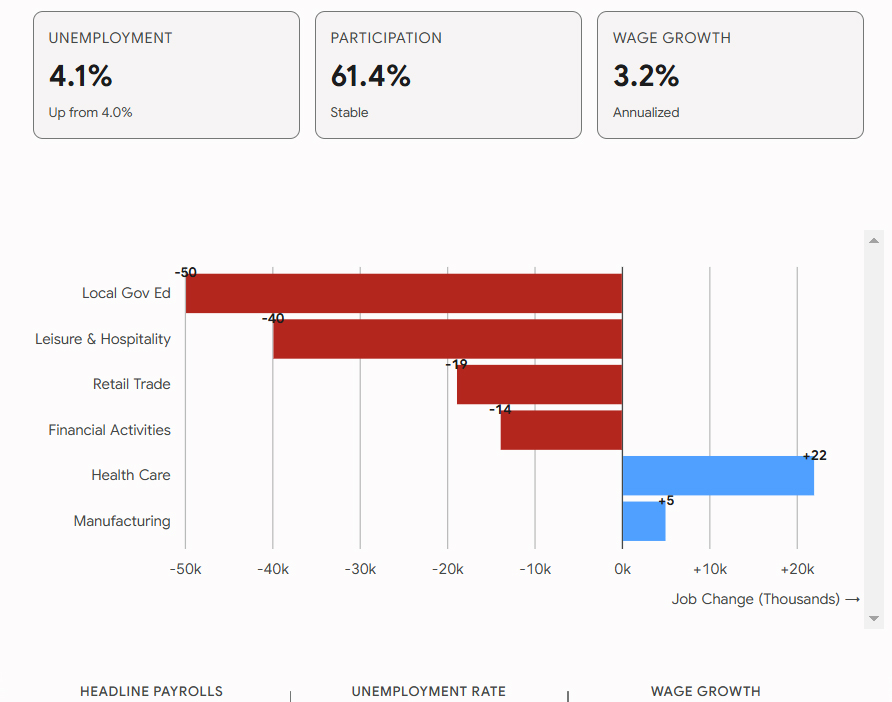
to 4.1%
from
4.2% in
June.
However,
analysts
noted
that the
lower
unemployment
rate was
largely
driven
by a dip
in labor
force
participation
rather
than
robust
hiring.
The
labor
force
participation
rate
fell to
61.4%,
indicating
that a
portion
of
jobless
Americans
opted to
step out
of the
workforce
altogether
rather
than
actively
seek
employment.
The
pullback
in July
hiring
was
primarily
concentrated
in local
government
education
and
traditional
retail,
while
healthcare
remained
one of
the few
resilient
spots in
the
broader
economy.
Local
government
education
lost
50,000
jobs due
to
seasonal
adjustments
and
budget
constraints
weighing
on local
public
school
hiring.
Retail
trade
dropped
by
19,000
positions,
with the
steepest
cutbacks
occurring
at
warehouse
clubs,
supercenters,
and fuel
dealers.
Financial
activities
lost
14,000
jobs due
to
continued
downsizing
across
credit
intermediation
and
insurance
carriers.
Health
care
gained
22,000
jobs,
maintaining
positive
momentum,
though
hiring
paced
below
its
12-month
average.
Wage
growth
also
stalled
during
the
month.
Average
hourly
earnings
for
private
nonfarm
employees
crept up
by just
two
cents to
$37.62,
bringing
the
annualized
wage
growth
rate
down to
3.2%.
The
average
workweek
held
firm at
34.3
hours.
July's
weak
employment
figures
complicate
the
outlook
for the
broader
U.S.
economy,
which
expanded
at a
modest
1.5%
annualized
rate in
the
second
quarter.
Prior to
Friday's
report,
Federal
Reserve
officials
had been
leaning
toward
maintaining
interest
rates to
ensure
sticky
inflation—running
above
3%—did
not
reaccelerate.
However,
a
contracting
job
market
significantly
elevates
the risk
of a
broader
economic
slowdown,
increasing
market
expectations
for
interest
rate
cuts to
safeguard
employment.
Slower
hiring
paired
with
cooling
wage
growth
limits
household
purchasing
power.
With
retail
trade
already
experiencing
cutbacks,
reduced
consumer
discretion
could
ripple
through
corporate
earnings
over the
final
half of
the
year.
Safe-haven
assets
rallied
immediately
following
the
release.
Spot
gold
prices
surged
over 3%
to cross
$4,350
per
ounce as
investors
recalibrated
growth
expectations
and
sought
refuge
from
labor
market
fragility.
|
|
|
|
|
|
|
|
|




 I
HI TECH NEWS
I
SPORTS
I
I
HI TECH NEWS
I
SPORTS
I