|
|
|
|
|
|
|
|
|
|
|
|
Benson
and
James
Spar in
Grand
Rapids
with
Early
Voting
Underway
Across
Michigan
Li Huang
-
State/National-Politics
Tell Us
USA News
Network
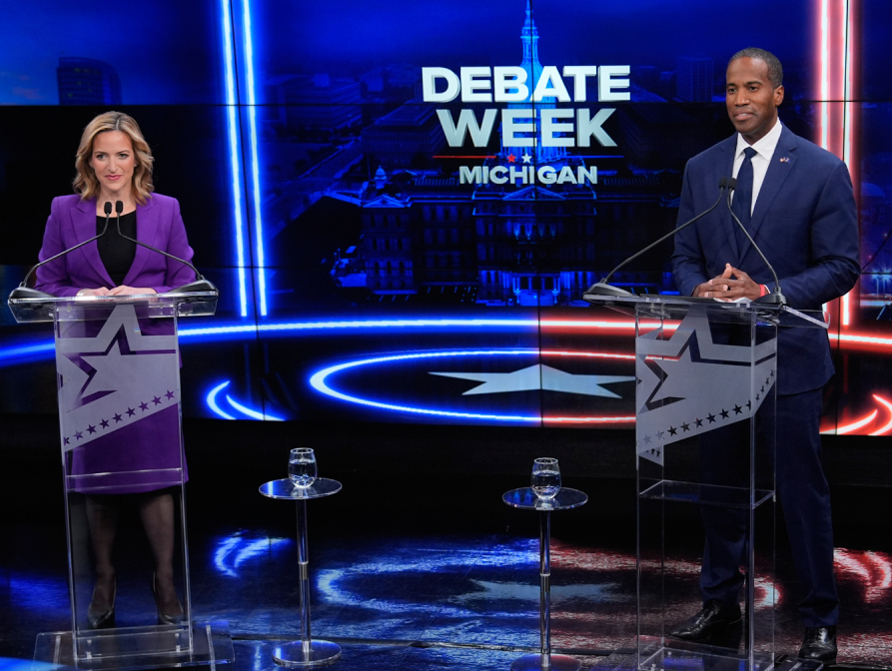
GRAND
RAPIDS,
MI - If
you came
to West
Michigan
expecting
a polite
exchange
of
policy
white
papers,
you
showed
up to
the
wrong
television
studio.
What
Democrat
Jocelyn
Benson
and
Republican
John
James
delivered
at
WOOD-TV
was less
of a
debate
and more
of a
bare-knuckle
stress
test for
two
campaigns
feeling
the
intense
pressure
of a
coin-flip
race.
With
early
voting
underway
and
hundreds
of
thousands
of
mail-in
ballots
already
out in
the
wild,
neither
candidate
had the
luxury
of
playing
defense,
and both
proved
it by
abruptly
executing
high-stakes
tactical
shifts
on live
television.
In a
campaign
cycle
defined
by voter
anxiety
over
rising
costs,
the most
telling
moments
came not
from
well-rehearsed
speeches,
but from
calculated,
opportunistic
mid-course
corrections
designed
to take
away an
opponent’s
best
weapon.
Benson
dropped
a
bombshell
on her
own
party’s
recent
playbook
by
calling
for a
temporary
suspension
of
Michigan’s
state
gas tax.
It was a
classic
populist
play
meant to
intercept
working-class
voters
battered
by
inflation,
but make
no
mistake
about
what it
actually
represented:
a direct
attempt
to seize
the
cost-of-living
narrative
from
Republicans
who have
spent
months
pounding
state
leadership
over
high
prices.
James
executed
an
equally
sharp
reverse
pivot on
technology
infrastructure.
After
months
of
public
signaling
in favor
of a
statewide
moratorium
on
massive
data
centers,
he
abandoned
the
mandate
on
stage,
insisting
that
state
government
should
not
dictate
local
policy.
It was a
rapid
retreat,
likely
triggered
by heavy
pressure
from
pro-business
donors
and tech
sector
interests,
wrapped
up in
the
language
of
conservative
local
control.
Throughout
the rest
of the
hour,
both
candidates
attempted
to pin
their
opponent
to
national
political
baggage.
Benson
repeatedly
invoked
Donald
Trump,
trying
to tie
national
tariffs
to James
as a
hidden
tax on
Michigan
manufacturers
and
autoworkers.
It is
the
standard
suburban
swing-voter
strategy
aimed at
keeping
moderate
independents
from
drifting
right.
James
countered
by
hammering
the
state’s
sluggish
economic
growth
and
abysmal
literacy
metrics,
pointing
out that
only
about
forty
percent
of
fourth-graders
read at
grade
level.
On
education,
James
floated
a return
to
third-grade
retention
rules
modeled
after
reforms
in
Mississippi,
while
Benson
rejected
state-mandated
retention,
framing
classroom
funding
and
wraparound
support
as the
real
path
forward.
On
energy,
the
divide
was
stark.
Benson
reaffirmed
her
commitment
to
Michigan’s
clean
energy
timeline
while
demanding
stricter
utility
regulation
to halt
profit-driven
rate
increases.
James
pushed
an
all-of-the-above
grid
expansion
featuring
renewables,
natural
gas, and
nuclear
power,
arguing
that
environmental
goals
mean
nothing
if
working
families
cannot
afford
to keep
their
lights
on.
Neither
contender
delivered
a clean
knockout
blow,
but that
was
never
realistic
in an
environment
this
polarized.
This
debate
was an
exercise
in base
protection
and
swift
damage
control.
Benson
demonstrated
a
willingness
to buck
her own
party
line to
guard
her
fragile
polling
lead,
while
James
proved
he can
duck a
policy
trap
even if
it
leaves
him open
to
accusations
of
changing
his
tune.
With
ballots
flowing
into
drop
boxes
every
single
day,
neither
campaign
can
afford a
single
wasted
turn as
the race
moves
toward
its
final
stretch.
This
Tell Us
USA News
Network
report
is
produced
in part
by Ai
and can
make
mistakes.
Please
contact
and let
us know
of any
errors
you may
find.
info@tellususa.com
|
|
|
|
|
|
|
|
|




 I
HI TECH NEWS
I
SPORTS
I
I
HI TECH NEWS
I
SPORTS
I