|
|
|
|
|
|
|
|
|
|
|
|
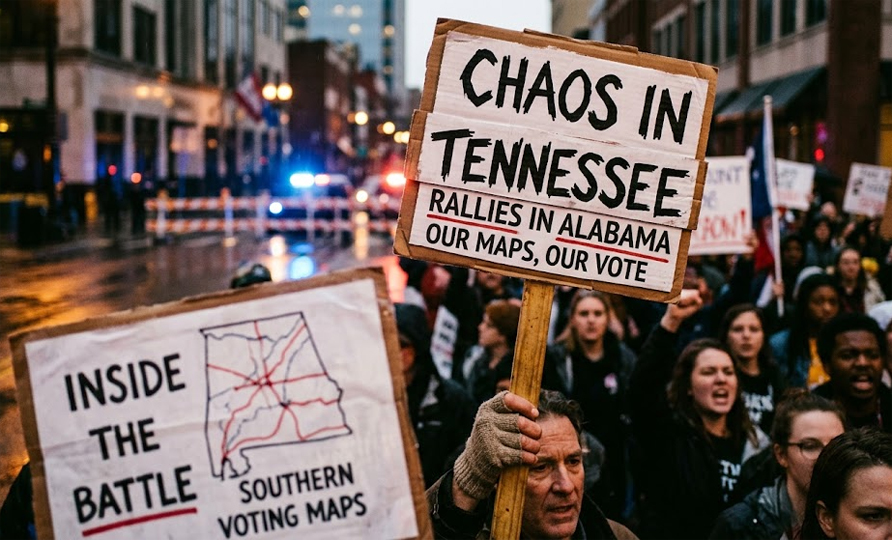
Chaos in
Tennessee,
Rallies
in
Alabama:
Inside
the
Battle
Over
Southern
Voting
Maps
Marc
Kennedy
-
National-Politics/Civil
Rights
Analyst
Tell Us
USA News
Network
NASHVILLE
-
Protests
are
spreading
across
the
South as
Americans
push
back
against
a wave
of
political
map-drawing
they say
is
designed
to
weaken
Black
voters'
power in
the
upcoming
November
elections.
The
spark
was a
Supreme
Court
decision
handed
down on
April
29,
2026. In
a 6–3
ruling
in a
case
called
Louisiana
v.
Callais,
the
Court's
conservative
majority
made it
significantly
harder
for
voters
to
challenge
maps
they
believe
were
drawn to
dilute
minority
representation.
The
ruling
effectively
gutted a
key
section
of the
Voting
Rights
Act of
1965 —
the
landmark
civil
rights
law that
for
decades
protected
voters
of color
from
discrimination
at the
ballot
box.
Justice
Elena
Kagan,
writing
in
dissent,
said the
decision
left
that
protection
"all but
a dead
letter."
Within
days,
Republican-led
state
legislatures
across
the
South
moved
quickly
to
redraw
their
congressional
maps,
sensing
an
opening
to
eliminate
districts
where
Black
voters
had
historically
chosen
their
own
representatives.
Tennessee
was the
first to
act.
Governor
Bill Lee
called a
special
legislative
session,
and
lawmakers
passed a
new map
that
carved
up
Memphis
—
Tennessee's
largest
majority-Black
city —
into
three
separate
congressional
districts,
each
leaning
Republican.
The move
effectively
eliminated
the only
Democratic-held
congressional
seat in
the
state.
The
session
was
chaotic.
One
Democratic
lawmaker
burned a
paper
replica
of a
Confederate
flag in
the
Capitol
hallway.
Another
state
senator
climbed
on top
of her
desk to
join
protesters
chanting
in the
gallery.
State
troopers
arrested
demonstrators
and
cleared
the
public
galleries.
After it
was
over,
the
Republican
House
Speaker
punished
Democratic
lawmakers
by
stripping
them of
their
committee
assignments.
Longtime
Memphis
congressman
Steve
Cohen,
who had
held the
seat for
nearly
two
decades,
announced
he would
not run
again.
"This is
the most
difficult
moment
I've had
as an
elected
official,"
he said.
A
federal
judge
has
scheduled
a
hearing
for May
20 to
consider
whether
to block
the new
maps.
Similar
scenes
played
out in
Alabama,
where
nearly
400
people
rallied
outside
the
State
House in
Montgomery.
Among
the
speakers
was
Sheyann
Webb-Christburg,
who as
an
eight-year-old
girl had
marched
across
the
Edmund
Pettus
Bridge
on
Bloody
Sunday
in 1965,
only to
be
attacked
by
police.
Now in
her late
sixties,
she
urged
the
crowd to
keep
fighting.
Alabama's
legislature
passed
bills
that
would
allow
the
state to
hold new
primary
elections
under
older
maps —
maps
that
federal
courts
had
previously
ruled
were
racially
discriminatory
— if the
Supreme
Court
allowed
it. The
Court
did
exactly
that on
May 11,
clearing
the way
for
Alabama
to use
those
blocked
maps.
Louisiana,
which
was at
the
center
of the
Supreme
Court
case,
also
moved to
scrap
its
second
majority-Black
congressional
district.
Florida
and
Texas
had
already
redrawn
their
maps
before
the
ruling
even
came
down.
Georgia's
governor
has
called a
session
to
redraw
that
state's
maps for
2028.
Mississippi
is
expected
to
follow.
Civil
rights
leaders
say the
coordinated
speed of
these
changes
— many
happening
while
primaries
were
already
underway
— is
unprecedented
and
deeply
troubling.
NAACP
President
Derrick
Johnson
asked
plainly:
"How do
we as a
country
really
address
the
effort
to
shrink
us
backwards
into a
1950s
reality?"
Organizers
with
Black
Voters
Matter
are
planning
marches
in
Selma,
Alabama,
framing
this
summer's
protests
as a
direct
continuation
of the
civil
rights
movement.
"This is
an altar
call,"
said
co-founder
LaTosha
Brown.
Lawsuits
are
being
filed
across
multiple
states.
Protests
are
growing.
And
civil
rights
advocates
say they
have no
intention
of
stopping
until
federal
voting
protections
are
restored.
|
|
|
|
|
|
|
|
|




 I
HI TECH NEWS
I
SPORTS
I
I
HI TECH NEWS
I
SPORTS
I