|
|
|
|
|
|
|
|
|
|
|
|
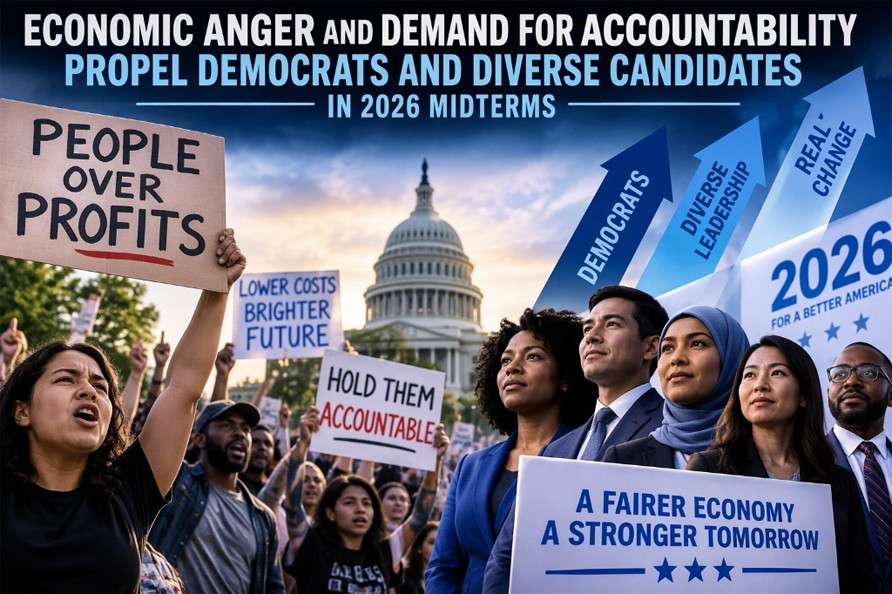
Economic
anger
and
demand
for
accountability
propel
Democrats
and
diverse
candidates
in 2026
midterms
Ashley
Roberts
-
Capitol
Hill
Correspondent
Tell Us
USA News
Network
WASHINGTON,
-
Republicans
controlled
Washington.
Voters
made
them
answer
for it.
Battered
by
public
anger
over
household
costs
and
President
Donald
Trump’s
exercise
of
power,
Republicans
lost
control
of
Congress
in
Tuesday’s
midterm
elections.
Democrats
rebuilt
support
among
young
voters,
recovered
ground
with
Black
and
Hispanic
voters,
and drew
backing
from
moderates
who
wanted a
Congress
willing
to
challenge
the
president.
The
result
carried
candidates
from
racial
and
religious
minorities
into
historic
offices.
But the
clearest
message
was
about
accountability:
voters
judged
the
party in
power
and
moved to
take
some of
that
power
away.
NBC News
projected
Democratic
control
of both
the
House
and
Senate.
The
scale of
the
rebuke
went
beyond
the loss
of
seats.
Republicans
entered
the
election
defending
an
administration
whose
economic
promises
had
collided
with
voters’
experience
at the
grocery
store,
the gas
pump and
the
doctor’s
office.
According
to the
Associated
Press
Voter
Poll,
about
two-thirds
of
voters
said
Trump’s
policies
had made
the
economy
worse.
Roughly
eight in
10 of
those
voters
backed
the
Democratic
candidate
in their
local
House
race.
That
finding
cuts
through
the
competing
campaign
explanations.
Whatever
economic
case the
White
House
made,
much of
the
electorate
was not
buying
it.
Voters
deeply
concerned
about
groceries,
health
care and
gasoline
overwhelmingly
supported
Democrats.
CBS News
exit
polling
likewise
found
that
voters
who
rated
the
economy
poorly,
or said
their
own
finances
had
worsened
over the
previous
two
years,
favored
Democratic
House
candidates.
Republicans
faced a
basic
problem
of
governing:
they
owned
the
promises,
and
voters
held
them
responsible
for the
results.
But this
was not
solely a
pocketbook
election.
It was
also a
judgment
on
whether
a
Republican
Congress
had
served
as an
independent
branch
of
government
or a
shield
for the
president.
About
seven in
10
voters
told the
AP that
Congress
was not
doing
enough
to check
presidential
power.
That
included
roughly
four in
10
Republicans.
More
than
half
said
government
corruption
was
crucial
to their
congressional
vote.
In NBC
News
exit
polling,
43% said
opposition
to Trump
was one
reason
for
their
vote.
Those
numbers
help
explain
how
Democrats
won
support
from
people
who
remained
skeptical
of the
party.
Voters
did not
have to
embrace
the
Democratic
agenda
in full
to
decide
that
Washington
needed
an
opposition
Congress.
Moderates
supplied
a
substantial
share of
that
support.
Roughly
two-thirds
voted
for
Democratic
House
candidates,
according
to the
AP,
compared
with
approximately
six in
10 who
supported
Kamala
Harris
in the
2024
presidential
election.
Democrats
also
recovered
support
among
constituencies
whose
movement
toward
Trump
two
years
earlier
had
raised
difficult
questions
about
the
party’s
coalition.
About
nine in
10 Black
voters
backed
Democratic
House
candidates,
compared
with
roughly
eight in
10 who
supported
Harris
in 2024.
Hispanic
voters
moved
toward
Democrats
as well.
Reporting
by NBC
News and
NPR
identified
affordability
concerns
and
opposition
to the
administration’s
immigration
crackdown
as
factors
in that
shift.
Young
voters
delivered
another
warning
to
Republicans.
About
six in
10
voters
under 30
said
opposition
to Trump
was one
reason
for
their
House
vote.
Roughly
half
said
they
were
angry
about
the
country’s
direction.
Those
comparisons
require
a
qualification.
Presidential
and
midterm
elections
draw
different
electorates.
The
figures
show
shifts
in
voting
patterns
among
demographic
groups;
they do
not
prove
that the
same
individuals
changed
sides.
The
election
nevertheless
challenged
the
notion
that
Republican
gains
among
younger
and
minority
voters
in 2024
had
become
permanent
political
commitments.
It also
produced
breakthroughs
in who
holds
power.
Former
Atlanta
Mayor
Keisha
Lance
Bottoms
won
Georgia’s
governorship,
becoming
the
nation’s
first
Black
female
governor.
Michigan
physician
Abdul
El-Sayed
became
the
first
Muslim
elected
to the
U.S.
Senate.
House
Democratic
leader
Hakeem
Jeffries
won
reelection
and
emerged
positioned
to
become
the
first
Black
speaker,
subject
to a
separate
vote by
the new
House.
Those
victories
were
significant
on their
own
terms.
They
were
not,
however,
proof
that
Americans
voted
primarily
to
advance
diversity.
The
distinction
matters.
Minority
candidates
winning
office
and
minority
voters
moving
toward
Democrats
are
related
developments,
but they
are not
interchangeable
explanations.
National
polling
cannot
establish
why
voters
chose
each
individual
candidate,
much
less
reduce
those
decisions
to race
or
religion.
The
results
also
resist a
tidy
claim
that the
country
moved
uniformly
left on
cultural
questions.
Voters
in
Arizona
and
Nebraska
approved
restrictions
on
transgender
athletes’
participation
in
school
sports
even as
candidates
from
varied
backgrounds
won
major
offices
elsewhere.
Democrats
would be
making
their
own
mistake
if they
treated
the
outcome
as an
unrestricted
mandate.
Only
about
half of
voters
viewed
the
party
favorably,
the AP
found.
About
one in
five
people
who
voted
for
Democratic
candidates
held a
negative
opinion
of the
party.
Voters
dissatisfied
with
both
parties
generally
broke
toward
Democrats
anyway.
That is
a
coalition
capable
of
winning
an
election.
Keeping
it will
require
more
than
celebrating
the
defeat
of
Republicans.
The
incoming
Democratic
majorities
will
face
pressure
to
investigate
the
administration,
assert
congressional
authority
and show
that
they
understand
the
financial
strain
voters
described.
They
will
also
have to
distinguish
between
the
powers
Congress
possesses
and the
promises
it
cannot
deliver
on its
own.
Tuesday’s
vote
gave
Democrats
power,
but not
a blank
check.
The same
electorate
that
punished
Republicans
for
failing
to meet
its
expectations
has now
put
Democrats
on
notice.
|
|
|
|
|
|
|
|
|




 I
HI TECH NEWS
I
SPORTS
I