|
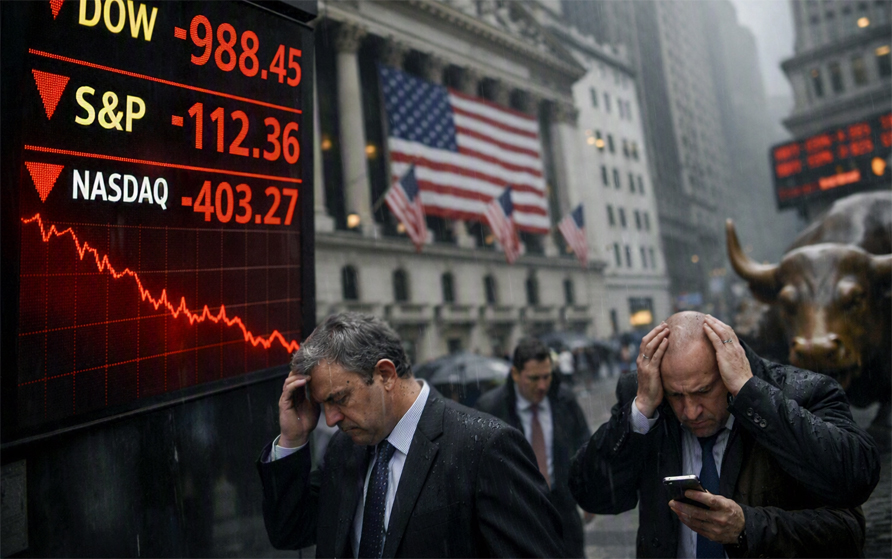
The Dow
Jones
Industrial
Average
dropped
631.33
points,
or
1.21%,
to close
at
51,461.78.
The
broader
S&P 500
lost
33.59
points,
or
0.44%,
ending
at
7,552.14,
while
the
Nasdaq
Composite
was
nearly
unchanged,
slipping
3.15
points,
or
0.01%,
to
25,978.43.
(Tell Us
USA Ai
image) |
|
|
|
|
|
|

|
 |
 |
|
|
|
|
|
|
|
|
|
|
|
|
Fed Rate
Hike
Sends
Wall
Street
Lower as
Inflation
Concerns
Persist
Charles
Mosley -
Business/Economy/Money
Tell Us
USA News
Network
NEW YORK
- U.S.
stocks
fell
sharply
Wednesday
after
the
Federal
Reserve
raised
its
benchmark
interest
rate by
a
quarter
percentage
point
and
signaled
that
additional
increases
could
follow
if
inflation
remains
elevated.
The
Federal
Open
Market
Committee
voted
unanimously
to lift
the
federal
funds
rate to
a target
range of
3.75% to
4%, the
Fed’s
first
rate
increase
in more
than
three
years.
The
decision
came as
the
central
bank
confronts
persistent
inflation
tied in
part to
higher
crude-oil
prices
and
broader
cost
pressures.
The Dow
Jones
Industrial
Average
dropped
631.33
points,
or
1.21%,
to close
at
51,461.78.
The
broader
S&P 500
lost
33.59
points,
or
0.44%,
ending
at
7,552.14,
while
the
Nasdaq
Composite
was
nearly
unchanged,
slipping
3.15
points,
or
0.01%,
to
25,978.43.
Wall
Street
initially
absorbed
the rate
move
relatively
calmly
because
investors
had
largely
expected
a
25-basis-point
increase.
Major
indexes
were
higher
before
the
Fed’s
announcement,
and the
technology-heavy
Nasdaq
at one
point
led the
advance.
That
changed
during
Fed
Chair
Kevin
Warsh’s
news
conference,
when his
comments
emphasized
that
inflation
remained
too high
and that
the
central
bank was
prepared
to
continue
tightening
policy.
Investors
interpreted
the
message
as a
warning
that
borrowing
costs
may stay
higher
for
longer,
or rise
further,
than
many had
anticipated.
The
Dow’s
steeper
decline
reflected
broad
pressure
on
economically
sensitive
blue-chip
stocks
and
financial
shares.
The S&P
500 also
turned
lower
after
briefly
gaining
ground,
while
the
Nasdaq’s
comparatively
small
loss
suggested
continued
support
for some
major
technology
and
semiconductor
companies.
Higher
interest
rates
can
pressure
the
stock
market
because
companies
face
higher
costs
for
financing
operations,
acquisitions,
inventory,
construction
and
expansion.
Consumers
also may
cut back
on
spending
as rates
rise for
credit
cards,
auto
loans
and
other
borrowing.
Higher
rates
can also
reduce
stock
valuations,
particularly
for
growth
companies
whose
prices
are
based on
expectations
of
earnings
further
in the
future.
Rising
Treasury
yields
may
shift
investor
money
from
stocks
to
government
bonds,
which
offer
higher
returns
with
lower
risk.
Real
estate,
utilities,
homebuilders
and
heavily
indebted
companies
are
often
especially
vulnerable
when
borrowing
costs
climb.
The
market
response
was
amplified
by
already-rising
Treasury
yields,
concerns
over
debt
levels
and an
earlier
surge in
crude-oil
prices,
all of
which
had
weighed
on
investors
before
the
Fed’s
decision.
The
Fed’s
move
underscores
the
tradeoff
facing
policymakers.
Raising
rates
can slow
inflation
by
reducing
borrowing
and
spending,
but it
can also
restrain
economic
growth,
weaken
consumer
demand
and
pressure
financial
markets.
For
investors,
the
immediate
concern
was not
simply
the
quarter-point
increase
announced
Wednesday.
It was
the
prospect
of a
sustained
period
of
tighter
monetary
policy.
If
inflation
fails to
ease,
the Fed
could
continue
raising
rates,
placing
additional
pressure
on stock
valuations
and
corporate
earnings.
Market
attention
will now
turn to
inflation
reports,
employment
data,
Treasury
yields
and oil
prices,
each of
which
could
influence
the
Fed’s
next
decision.
A
cooling
in
inflation
could
lessen
the case
for
additional
rate
increases,
while
continued
price
pressure
could
reinforce
expectations
for more
restrictive
policy.
Wednesday’s
selloff
showed
that
investors
were
less
concerned
about
the
expected
rate
increase
itself
than the
possibility
that
higher
borrowing
costs
could
remain
in place
longer
than
previously
anticipated.
|
|
|
|
|
|
|
|
|

 I
HI TECH NEWS
I
SPORTS
I
I
HI TECH NEWS
I
SPORTS
I