|
|
|
|
|
|
 |
|
|
|
| |
Inside
Trump's
Make-or-Break
Address
Amid
Tariff
Turmoil
and
Polling
Slump
Ashley
Roberts
-
Capitol
Hill
Tell Us
USA News
Network
WASHINGTON
-
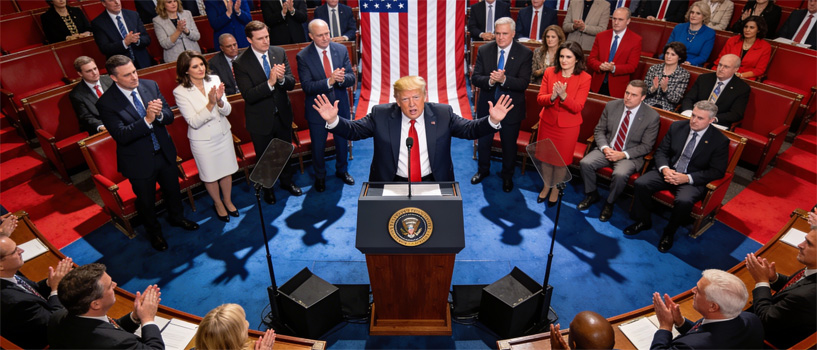
President
Donald
Trump
heads
into
tonight’s
State of
the
Union
address
facing a
restless
electorate,
an
uneasy
Congress
and
midterm
elections
that
could
snap his
party’s
narrow
grip on
Capitol
Hill.
The
speech
is
expected
to
double
as both
a
governing
blueprint
and a
campaign
kickoff,
framed
around
hard-edged
themes
of
immigration,
tariffs,
crime
and
“peace
through
strength”
abroad.
Behind
the
scenes,
Republicans
know
this may
be their
last
best
chance
to reset
the
political
narrative
before
the 2026
midterms,
when
even a
small
shift of
House
seats
could
hand
Democrats
the
gavel.
Trump’s
approval
remains
soft,
with
polling
showing
a
majority
of
Americans
skeptical
the
country
is
better
off than
a year
ago and
deeply
divided
over his
performance.
That
makes
tonight
less a
standard
status
report
and more
a
prime-time
argument
that his
second
term is
on
track,
despite
court
setbacks
on
tariffs,
persistent
affordability
concerns
and
mounting
questions
over his
handling
of
immigration
enforcement.
On
domestic
policy,
advisers
say
Trump is
likely
to lean
heavily
into
immigration
and “law
and
order,”
pointing
to
stepped-up
enforcement
while
brushing
past
bipartisan
alarm
over
high-profile
incidents
involving
U.S.
citizens
caught
up in
raids.
He is
expected
to again
call for
more
wall
construction,
aggressive
use of
troops
at the
southern
border,
tighter
asylum
rules
and
renewed
travel
bans,
betting
that
images
of
toughness
still
resonate
with his
base
even as
suburban
voters
show
fatigue
with the
rhetoric.
The
White
House
has
already
previewed
a
law-and-order
frame
for the
address,
pairing
support
for
police
and ICE
with
warnings
that
Democrats
are
undermining
public
safety.
The
economic
section
of the
speech
may be
the most
politically
delicate.
Trump
continues
to
describe
the
economy
as the
“strongest
ever,”
highlighting
cooling
inflation
and
pockets
of job
growth,
yet
polls
and
price
data
show
many
families
still
squeezed
by high
costs
for
food,
energy
and
housing.
A recent
Supreme
Court
ruling
knocked
out a
key
legal
mechanism
behind
his
tariff
strategy,
and
critics
in both
parties
warn
that
broad
new
import
taxes
could
raise
prices
further
even as
the
president
pitches
them as
a tool
to
revive
manufacturing
and fund
tax
cuts.
Expect
Trump to
reassert
plans
for
universal
baseline
tariffs,
higher
duties
on China
and
promises
of new
individual
tax
breaks,
including
ideas
such as
exempting
overtime
and tip
income,
restoring
more
generous
state
and
local
tax
deductions
and
carving
out
targeted
credits
for
families
and
caregivers.
The
political
bet is
clear:
blame
inflation
on
opponents
and
global
elites,
while
selling
tariffs
and tax
relief
as
populist
economic
nationalism.
Foreign
policy
will
likely
feature
prominently,
though
details
remain
fluid as
multiple
crises
compete
for
airtime.
Trump
has
pledged
a “peace
through
strength”
doctrine
that
couples
a more
muscular
military
posture
with
vows to
quickly
end the
war in
Ukraine
and
restore
calm in
the
Middle
East,
even as
his
critics
accuse
him of
sending
mixed
signals
to
allies.
The
administration
has
increased
deployments
in key
regions
and
spoken
of tough
lines on
Iran and
China,
while
simultaneously
questioning
the cost
of
long-term
support
for Kyiv
and
grumbling
about
NATO
burden-sharing.
With
Gaza,
Ukraine
and
U.S.-China
tensions
all
simmering,
the
president
is
expected
to claim
he alone
can
prevent
“World
War
III,” a
message
calibrated
as much
to
swing-state
voters
as to
foreign
capitals.
Inside
the
chamber,
the
optics
will
underscore
a deeply
polarized
era.
Republicans,
who
currently
control
both
chambers
but by
historically
thin
margins,
are
eager to
project
unity
after
months
of
intraparty
feuding
that has
slowed
their
agenda.
Democrats,
smelling
opportunity
in
November,
are
poised
to use
visible
displays
of
dissent
and
their
official
response
to cast
Trump as
out of
touch
with
public
concerns
on
abortion
rights,
democracy
and
kitchen-table
economics.
With
history
running
against
the
president’s
party in
midterms
and
forecasters
already
giving
Democrats
a real
shot at
taking
back the
House,
the
stakes
for
Trump’s
performance
tonight
extend
far
beyond
the
applause
lines.
For
seasoned
observers,
the real
measure
of
success
will not
be the
laundry
list of
promises,
but
whether
he can
convince
a
skeptical
middle
that his
second-term
turbulence
is a
feature
of
disruptive
change,
not a
sign of
drift.
|
|
|
|
|
|
|
|
|




 I
HI TECH NEWS
I
SPORTS
I
I
HI TECH NEWS
I
SPORTS
I