|
The
ruling
invalidates
the
so-called
"reciprocal"
tariffs
that
Trump
announced
on what
he
called
"Liberation
Day" in
April
2025,
which
imposed
duties
ranging
from 10
to 50
percent
on key
trading
partners
such as
India
and
Brazil,
and as
high as
145
percent
on
China. |
|
|
|
|
|
 |
 |
 |
|
|
|
|
|
|
 |
| |
Supreme
Court
Strikes
Down
Trump
Emergency
Tariffs
in Major
Rebuke
Marc
Kennedy
-
National-Politics
Tell Us
USA News
Network
WASHINGTON
- The
United
States
Supreme
Court
delivered
a
historic
and
stinging
defeat
to
President
Donald
Trump on
Friday,
ruling
6-3 that
his
sweeping
global
tariffs
were
illegal,
striking
down one
of the
most
consequential
economic
policies
of his
second
term.
Chief
Justice
John
Roberts
authored
the
majority
opinion,
concluding
that the
International
Emergency
Economic
Powers
Act —
the 1977
law
Trump
invoked
to
justify
placing
import
duties
on goods
from
virtually
every
country
on earth
— does
not
grant
the
president
the
authority
to
impose
tariffs.
Trump
was the
first
president
in the
law's
nearly
50-year
history
to
attempt
to use
it in
such a
manner.
"IEEPA
contains
no
reference
to
tariffs
or
duties,"
Roberts
wrote in
the
majority
opinion.
"The
Government
points
to no
statute
in which
Congress
used the
word
'regulate'
to
authorize
taxation.
And
until
now no
President
has read
IEEPA to
confer
such
power."
The
ruling
invalidates
the
so-called
"reciprocal"
tariffs
that
Trump
announced
on what
he
called
"Liberation
Day" in
April
2025,
which
imposed
duties
ranging
from 10
to 50
percent
on key
trading
partners
such as
India
and
Brazil,
and as
high as
145
percent
on
China.
The
court
did not,
however,
strike
down
tariffs
Trump
imposed
through
other
legal
authorities,
meaning
roughly
a third
of his
tariff
regime
remains
in place
for now.
The
decision
was a
rare and
significant
rebuke
of the
Trump
administration
by a
Supreme
Court
that has
largely
sided
with the
White
House in
emergency
rulings
over the
past
year on
immigration,
government
spending
cuts,
and the
firing
of
federal
agency
heads.
It marks
the
first
time the
high
court
issued a
final
ruling
on the
underlying
legality
of a
major
Trump
policy.
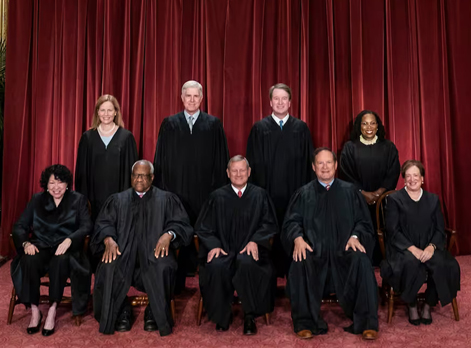
Justices
Clarence
Thomas,
Samuel
Alito,
and
Brett
Kavanaugh
dissented.
Kavanaugh,
in his
dissenting
opinion,
argued
that
tariffs
are a
traditional
tool
used to
regulate
importation
— a
power
the
IEEPA
does
explicitly
grant —
and
warned
that the
ruling's
short-term
impact
"could
be
substantial,"
particularly
regarding
the
potentially
chaotic
process
of
refunding
more
than
$175
billion
in
tariffs
already
collected.
The
three
liberal
justices
in the
majority
— Elena
Kagan,
Sonia
Sotomayor,
and
Ketanji
Brown
Jackson
— agreed
with the
outcome
but took
a
different
route to
get
there.
Kagan
wrote
that
ordinary
principles
of
statutory
interpretation
were
sufficient
to
strike
down the
tariffs,
without
needing
to rely
on the
"major
questions
doctrine"
that
Roberts
invoked.
Trump
received
word of
the
ruling
while
meeting
with a
group of
governors
at the
White
House.
According
to a
governor
present
in the
room,
upon
reading
the note
he
muttered
"that's
a
disgrace"
and then
left
shortly
after.
At a
press
conference
held at
the
White
House on
Friday
afternoon,
the
president
was
blunt
and
combative.
He
called
the
ruling
"deeply
disappointing"
and said
he was
"absolutely
ashamed"
of the
justices
who
voted
against
him. He
went
further,
labeling
those
justices
a
"disgrace
to our
nation"
and
accusing
them of
being
"very
unpatriotic
and
disloyal
to our
Constitution."
"It is
my
opinion
that the
court
has been
swayed
by
foreign
interests
and a
political
movement
that is
far
smaller
than
people
would
ever
think,"
Trump
told
reporters.
Despite
the
defeat,
Trump
moved
quickly
to
signal
defiance.
Within
hours of
the
ruling,
he
announced
he would
impose a
new 10
percent
across-the-board
global
tariff
using
Section
122 of
the
Trade
Act of
1974 — a
different
legal
authority
from the
one the
court
struck
down —
effective
immediately.
He also
said he
would
pursue
additional
tariffs
under
Section
301,
which
covers
unfair
trade
practices.
He vowed
to go in
an "even
stronger"
direction
on
tariffs
and
insisted
he did
not need
Congress
to act,
though
he also
acknowledged
he would
ask
Congress
for
support
and
expected
to get
it.
The
ruling
is
expected
to set
off a
massive
wave of
refund
litigation.
Companies
including
Costco,
Revlon,
and
portions
of the
Toyota
Group
had
already
filed
lawsuits
in
anticipation
of the
decision,
seeking
to
recover
billions
of
dollars
in
duties
paid.
The
Supreme
Court's
opinion
did not
lay out
a
process
for how
refunds
would be
handled,
leaving
that
battle
to the
lower
courts.
Democratic
leaders
were
quick to
celebrate.
House
Minority
Leader
Hakeem
Jeffries
called
it "a
big
victory
for the
American
people
and
another
crushing
defeat
for the
wannabe
King."
Senate
Minority
Leader
Chuck
Schumer
called
it "a
win for
the
wallets
of every
American
consumer."
Some
Republicans
also
quietly
welcomed
the
decision.
Representative
Don
Bacon of
Nebraska
praised
the
ruling
as a
vindication
of the
Constitution's
separation
of
powers,
writing
that the
court
had
correctly
affirmed
Congress's
authority
over
tariff
policy.
House
Speaker
Mike
Johnson
said
Congress
and the
administration
would
work
together
in the
coming
weeks to
determine
the best
path
forward.
Legal
scholars
noted
that
Friday's
decision
represents
the
clearest
signal
yet that
the
Supreme
Court is
prepared
to draw
limits
around
Trump's
use of
executive
emergency
powers.
Justice
Neil
Gorsuch,
in a
concurring
opinion,
issued
what
amounted
to a
pointed
appeal
to the
broader
federal
government
to
return
to the
business
of
legislating
through
Congress
rather
than
bypassing
it
through
executive
declarations.
The
economic
fallout
from the
ruling
remains
to be
seen.
Analysts
noted
that
prices
are
unlikely
to drop
overnight,
as many
companies
absorbed
tariff
costs
rather
than
passing
them
directly
to
consumers.
A Tax
Foundation
economist
estimated
that the
tariffs
still in
effect
after
the
ruling
would
still
amount
to a
$400
annual
tax
increase
per
household
in 2026.
|
|
|
|
|
|
|
|
|

 I
HI TECH NEWS
I
SPORTS
I
I
HI TECH NEWS
I
SPORTS
I