|
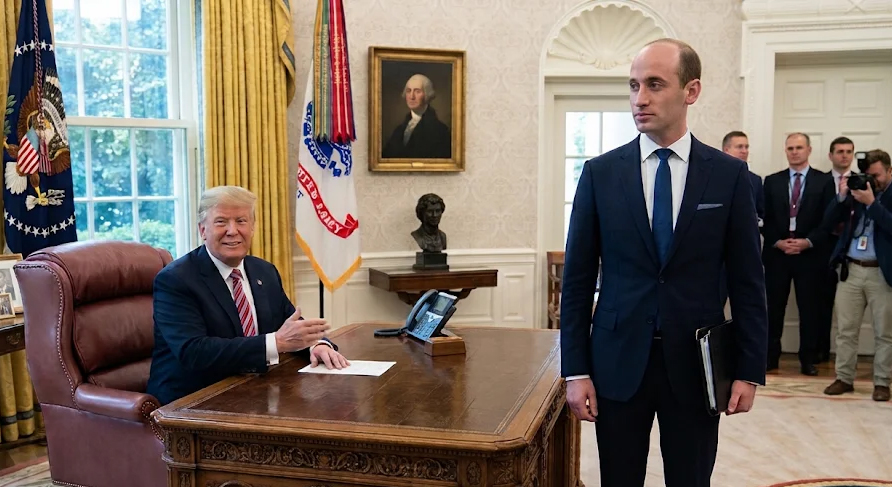
Stephen
Miller,
the
architect
of much
of
Trump’s
hard-line
immigration
agenda
and
among
his
fiercest
public
defenders,
will
replace
Susie
Wiles as
White
House
chief of
staff on
Nov. 9.
(Tell Us
USA Ai
image) |
|
|
|
|
|
 |
 |
 |
|
|
|
|
|
|
|
|
|
|
| |
Trump
Hands
Stephen
Miller
the
Controls
as GOP
Question
Their
Course
Diane
Simpson
- White
House
Correspondent
Tell Us
USA News
Network
WASHINGTON
-
Confronted
with a
midterm
defeat
that
cost
Republicans
control
of both
chambers
of
Congress,
President
Donald
Trump
has
chosen
not a
conciliator
to lead
his
White
House,
but one
of its
most
uncompromising
combatants.
Stephen
Miller,
the
architect
of much
of
Trump’s
hard-line
immigration
agenda
and
among
his
fiercest
public
defenders,
will
replace
Susie
Wiles as
White
House
chief of
staff on
Nov. 9.
The
appointment
puts a
trusted
ideological
ally in
charge
of the
president’s
operation
at
precisely
the
moment
Republicans
are
arguing
over
whether
that
ideology
has
become
an
electoral
liability.
Personnel
decisions
do not
answer
every
question
about a
presidency’s
direction.
This one
answers
an
important
one:
Trump is
handing
greater
authority
to an
adviser
identified
with the
policies
and
confrontational
rhetoric
that
some
Republicans
now want
reassessed.
For a
party
searching
for
evidence
that the
White
House
absorbed
the
election’s
warning,
Miller’s
promotion
offers
little
reassurance.
Trump
announced
the
appointment
Friday,
calling
Miller
“one of
my
trusted
advisors.”
Miller
answered
with a
declaration
of
loyalty,
saying
he was
“honored
beyond
words”
and
promising
to
“Fight
with all
of our
soul to
support
our
President.”
Missing
from
that
exchange
was any
public
acknowledgment
of the
central
question
confronting
Republicans
after
their
defeat:
What
needs to
change?
Miller’s
appointment
does not
settle
that
debate.
It does
establish
who will
occupy
one of
the most
powerful
positions
in the
administration
while it
unfolds.
At 41,
Miller
has
spent
much of
his
professional
life
advancing
the
immigration
politics
that
helped
define
Trump’s
rise. He
worked
for
then-Sen.
Jeff
Sessions
of
Alabama,
helped
oppose
the
bipartisan
immigration
legislation
that
passed
the
Senate
in 2013,
and
joined
Trump’s
presidential
campaign
in
January
2016.
He
subsequently
helped
write
Trump’s
Republican
National
Convention
acceptance
address
and his
2017
inaugural
address.
More
consequentially,
he
helped
translate
the
president’s
campaign
rhetoric
into
government
policy.
During
Trump’s
first
term,
Miller
helped
develop
travel
restrictions
targeting
several
predominantly
Muslim
countries
and
championed
the
separation
of
migrant
children
from
their
parents
at the
southern
border.
“The
message
is that
no one
is
exempt
from
immigration
law,” he
said in
2018,
defending
a policy
that
provoked
widespread
opposition.
In
Trump’s
second
term,
Miller
became a
driving
force
behind
the
administration’s
mass-deportation
campaign.
He also
helped
advance
its use
of the
Alien
Enemies
Act
against
people
the
administration
accused
of
belonging
to the
Venezuelan
gang
Tren de
Aragua,
an
effort
that
triggered
extensive
legal
challenges
over
deportations
outside
the
traditional
immigration-court
process.
Those
battles
illuminate
the
record
he
brings
to the
chief of
staff’s
office:
an
insistence
on
aggressive
enforcement
and a
willingness
to
defend
executive
action
through
sustained
political
and
legal
confrontation.
They
also
explain
why his
promotion
carries
significance
beyond
an
ordinary
staff
reshuffle.
Miller
is not
simply a
manager
arriving
to
improve
the
White
House’s
internal
machinery.
He is a
principal
author
of the
agenda
that
machinery
has been
carrying
out.
His new
responsibilities
will
nevertheless
demand
more
than
ideological
conviction.
A chief
of staff
must
control
access
to the
president,
impose
discipline
on
competing
advisers,
coordinate
policy
and help
determine
which
fights
the
administration
can
afford
to wage.
With
Democrats
taking
control
of
Congress,
Miller
will
face an
opposition
empowered
to
scrutinize
the
administration
and
challenge
its
priorities.
The
distinction
between
rallying
supporters
and
running
a White
House is
about to
become
considerably
more
consequential.
Miller’s
own
language
illustrates
the
difficulty
ahead.
In
August
2025, he
described
the
Democratic
Party as
“a
domestic
extremist
organization.”
He will
now help
manage a
presidency
that
must
deal
with
Democratic
congressional
majorities.
That
does not
make
cooperation
impossible.
It does
make his
capacity
to
distinguish
political
combat
from
governing
necessity
an
immediate
test of
his
leadership.
Republican
unease
is
already
visible.
Rep.
Marlin
Stutzman
of
Indiana
called
for
“self-reflection”
after
the
midterm
losses.
Told
that
Miller
would
replace
Wiles,
he
called
the
appointment
a
“horrible
decision,”
according
to
POLITICO.
Other
Republicans
have
been
less
willing
to
criticize
Trump
publicly.
But the
underlying
dispute
is
substantial:
whether
the
party
lost
because
it
failed
to
communicate
its
agenda
or
because
voters
rejected
important
elements
of it.
Sen. Ted
Cruz has
called
for
greater
attention
to
economic
concerns.
Florida
Gov. Ron
DeSantis
described
the
election
result
as “a
rebuke
of the
president
and
Congress,”
POLITICO
reported.
These
are not
identical
prescriptions.
They do,
however,
point
toward a
question
the
appointment
leaves
unresolved:
whether
the
administration
intends
to
reconsider
its
approach
or
simply
prosecute
it more
forcefully.
Calling
Miller
the
Republican
Party’s
new face
requires
a
distinction.
He has
not won
a
national
election,
does not
lead
Republicans
in
Congress
and has
not
displaced
Trump as
the
party’s
dominant
figure.
His
power
comes
from
proximity,
presidential
confidence
and
influence
over
policy.
His
promotion
strengthens
all
three.
It also
gives
Republican
lawmakers
a more
prominent
official
with
whom to
associate
the
administration’s
direction.
Members
preparing
to
defend
their
records
will
have to
weigh
their
loyalty
to the
president
against
the
political
consequences
of a
White
House
increasingly
identified
with
Miller’s
approach.
Trump
could
have
used
this
appointment
to
signal a
broader
coalition,
a
different
governing
emphasis
or a
willingness
to
accommodate
Republican
criticism.
Instead,
he
elevated
an
adviser
whose
record
is
defined
by
loyalty
and
confrontation.
The
election
gave
Republicans
a reason
to
question
their
course.
Miller’s
promotion
suggests
the
president’s
first
answer
is to
press
ahead.
This
Tell Us
USA News
Network
report
is
produced
in part
by Ai
and can
make
mistakes.
Please
contact
and let
us know
of any
errors
you may
find.
info@tellususa.com
|
|
|
|
|
|
|
|
|

 I
HI TECH NEWS
I
SPORTS
I