|
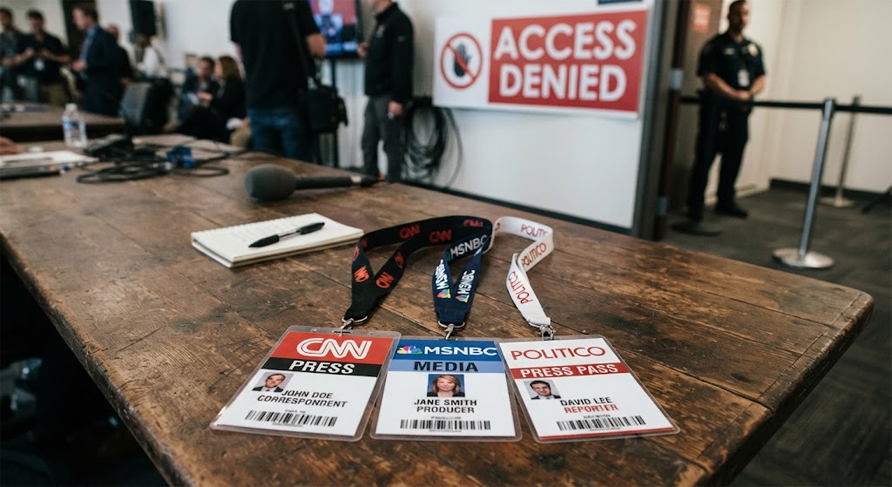
Trump
announced
the
action
Friday
in a
Truth
Social
post,
saying
the
three
outlets
were
being
banned
“effective
immediately”
because
of what
he
called
their
constant
reporting
of “fake
news.”
(Tell Us
USA Ai
image) |
|
|
|
|
|
 |
 |
 |
|
|
|
|
|
|
|
|
|
|
| |
Trump's
Media
Ban
Triggers
High-Stakes
Constitutional
Confrontation
with
Press
Corps
Li Haung
-
National-Politics
Tell Us
USA News
Network
WASHINGTON
- Major
news
organizations
and
press
freedom
watchdogs
are
launching
a fierce
pushback
following
President
Donald
Trump’s
decision
to ban
journalists
from
CNN, MS
NOW
(formerly
MSNBC),
and
Politico
from the
White
House
grounds.
The
escalation
reached
a head
over the
weekend
when
White
House
reporters,
including
CNN’s
Betsy
Klein,
MS NOW’s
Akayla
Gardner,
and
Politico’s
Cheyenne
Haslett,
were
turned
away by
Secret
Service
officers
at the
gates.
Their
hard
press
passes
were
deactivated
and
confiscated,
forcing
reporters
to
broadcast
live
from the
sidewalk
along
Pennsylvania
Avenue.
President
Trump
announced
the
sweeping
ban on
Truth
Social,
explicitly
linking
the
decision
to
coverage
he
deemed
unfavorable.
He wrote
that he
was
banning
Fake
News
CNN,
MSNOW,
and
Politico
from the
White
House as
a result
of their
constant
reporting
of fake
news,
threatening
that
other
fake
news
media
outlets
could
soon
follow.
Speaking
in the
Oval
Office
shortly
after,
Trump
conceded
that the
move
might
face
legal
hurdles,
but
doubled
down on
his
actions,
stating
that he
does not
want
them in
his
office
and does
not
think a
court
should
allow
fake
news to
be
written
day
after
day. He
added
that he
believes
someone
has a
right to
keep
them
away if
they are
going to
write
false
stories
all the
time.
The
affected
outlets
immediately
condemned
the
move,
signaling
that
legal
action
under
First
Amendment
protections
is
imminent.
CNN
stated
that its
White
House
reporting
remains
fair and
accurate,
warning
that
government
interference
sets a
dangerous
precedent,
asserting
that
they
have a
right
under
the U.S.
Constitution
to do
that
reporting
without
hindrance
or
interference
from the
government
and that
if the
ban goes
ahead,
it would
be an
illegal
assault
on that
fundamental
and
constitutionally
protected
right.
MS NOW
declared
its
intention
to take
formal
steps to
reverse
the
decision,
stating
that the
White
House
belongs
to the
American
people
and the
decisions
made
inside
are
funded
by tax
dollars,
and that
MS NOW
intends
to take
any and
all
steps
necessary
to
defend
its
First
Amendment
rights.
POLITICO
rejected
claims
made by
the
administration
regarding
its
editorial
integrity,
stating
that
they
will
continue
to
fairly
report
on this
White
House
and
future
ones,
and will
vigorously
defend
their
First
Amendment
rights
against
any
attempt
to
restrict
them.
The
White
House
Correspondents'
Association
called
on the
administration
to
restore
access
immediately.
Association
President
Jacqui
Heinrich
warned
that a
standard
used to
exclude
one news
outlet
because
of its
coverage
could be
applied
to any
outlet
in the
future,
emphasizing
that an
independent
press
must be
allowed
to
scrutinize
elected
officials.
Press
freedom
groups
were
equally
unequivocal.
Seth
Stern,
chief of
advocacy
at the
Freedom
of the
Press
Foundation,
called
the ban
difficult
to
imagine
a more
blatant
violation
of the
First
Amendment
than
banning
news
outlets
from the
People's
House
for
criticizing
the
government.
Legal
experts
point
out that
the
administration
faces
significant
constitutional
hurdles.
Under
the
landmark
1977
D.C.
Circuit
Court
precedent
Sherrill
v.
Knight,
while
the
White
House is
not
required
to grant
entry to
everyone,
once it
establishes
credentialing
facilities
for
journalists,
it
cannot
deny or
revoke
access
based on
viewpoint
discrimination
or
content
of
coverage.
The
current
legal
showdown
mirrors
events
from
Trump's
first
term in
2018,
when the
administration
revoked
the
press
pass of
CNN
reporter
Jim
Acosta.
A
federal
court
quickly
ordered
the
White
House to
restore
Acosta's
credentials,
citing
due
process
and
First
Amendment
protections,
a ruling
the
administration
chose
not to
appeal.
Despite
historical
precedent,
the
administration
appears
intent
on
testing
the
limits
of
executive
power
over
press
access.
Defense
Secretary
Pete
Hegseth
voiced
full
support
for the
president's
decision,
signaling
a
unified
stance
across
the
cabinet.
With the
three
targeted
outlets
preparing
their
legal
responses,
the
conflict
is
expected
to move
rapidly
from
Pennsylvania
Avenue
to
federal
court.
|
|
|
|
|
|
|
|
|

 I
HI TECH NEWS
I
SPORTS
I
I
HI TECH NEWS
I
SPORTS
I