|
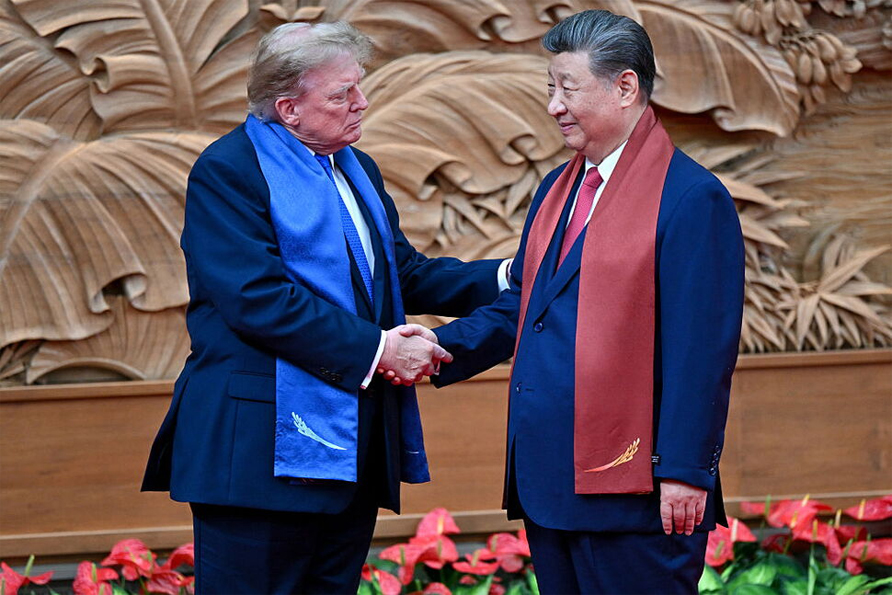
China's
President
Xi
Jinping
(R)
shakes
hands
with
U.S.
President
Donald
Trump
before
leaders
gather
for a
group
photo
during
the
Asia-Pacific
Economic
Cooperation
(APEC)
Summit
on Nov.
19,
2026, in
Shenzhen,
China.
(Greg
Baker -
Pool|Getty
Images) |
|
|
|
|
|
 |
 |
 |
|
|
|
|
|
|
|
|
|
|
| |
Trump's
Mixed
Messages
Put
White
House
Credibility
Under
Scrutiny
After
China
Summit
Diane
Simpson
- White
House
Correspondent
Tell Us
USA News
Network
WASHINGTON,
November
20, 2026
—
President
Donald
Trump
returned
to the
White
House
briefing
room
Friday
determined
to sell
a
narrative
of
American
strength,
diplomatic
success
and
economic
momentum.
But
nearly
90
minutes
of
answers,
declarations
and
political
deflections
exposed
a more
complicated
picture
of an
administration
struggling
to
reconcile
its
ambitions
with
mounting
political
and
international
challenges.
Fresh
from an
extraordinary
three-way
meeting
with
Chinese
President
Xi
Jinping
and
Russian
President
Vladimir
Putin in
Shenzhen,
Trump
portrayed
the
gathering
as a
historic
diplomatic
achievement,
repeatedly
praising
his
personal
relationships
with
both
leaders
and
declaring
that the
United
States
had
entered
the
negotiations
from a
position
of
unmatched
strength.
He rated
the
meeting
a 12 out
of 10.
What he
did not
deliver
was an
equally
convincing
accounting
of what
the
United
States
actually
secured.
The
summit
produced
broad
statements
about
nuclear
risks,
international
cooperation
and
global
stability,
but no
announced
breakthrough
on the
war in
Ukraine,
the
conflict
involving
Iran,
arms-control
negotiations
or the
growing
technological
rivalry
between
Washington
and
Beijing.
The
distinction
between
diplomatic
theater
and
tangible
results
was
difficult
to
ignore.
Trump
appeared
far more
interested
in
emphasizing
the
relationships
he had
established
than
explaining
what
concessions,
commitments
or
enforceable
agreements
emerged
from the
encounter.
That
distinction
matters.
For
months,
Trump
has
promoted
his
personal
relationships
with
authoritarian
leaders
as a
central
instrument
of
American
foreign
policy.
Friday's
performance
reinforced
that
approach,
but also
exposed
its
limitations.
Access
to Xi
and
Putin is
not the
same as
securing
their
cooperation,
and
expressions
of
goodwill
are not
substitutes
for
agreements
that
advance
American
interests.
The
president's
comments
on Iran
offered
another
revealing
example
of the
administration's
competing
messages.
Trump
insisted
Tehran
must
never
obtain a
nuclear
weapon
and
maintained
that his
decision
to
pursue
military
action
was
justified.
At the
same
time, he
acknowledged
the
economic
and
political
consequences
of the
conflict,
including
higher
fuel
costs
that
have
become
an issue
for
American
voters.
Asked
about
Vice
President
JD
Vance's
assessment
that the
Iran war
contributed
to
Republican
losses
in the
midterm
elections,
Trump
accepted
the
explanation
as
reasonable.
Yet he
made
clear he
would
make the
same
decision
again.
It was
an
extraordinary
political
admission
wrapped
inside a
familiar
presidential
defense:
the
administration
recognizes
that its
decisions
carry
domestic
consequences
but
remains
unwilling
to
reconsider
the
policies
producing
them.
The
contradiction
is
particularly
significant
following
the
Republican
Party's
devastating
midterm
performance,
which
handed
Democrats
control
of
Congress
and
sharply
complicated
the
remainder
of
Trump's
presidency.
Rather
than
directly
accepting
responsibility
for the
losses,
Trump
suggested
his
absence
from the
ballot
was a
factor
and
defended
his
administration's
record.
His
explanation
did
little
to
address
the
broader
political
question
of
whether
voters
were
rejecting
specific
administration
policies
or
expressing
dissatisfaction
with the
direction
of the
country.
The
consequences
are
immediate.
A
Democratic-controlled
Congress
means
tougher
oversight,
more
aggressive
investigations
and a
substantially
more
difficult
legislative
environment
for the
White
House.
Trump's
economic
presentation
was
equally
ambitious.
He
touted
falling
gasoline
prices,
American
investment
and the
administration's
economic
agenda
while
announcing
that
U.S.
companies
constructing
data
centers
overseas
would
face
what he
described
as a
tremendous
tax.
He
offered
few
details
about
how such
a policy
would be
implemented,
but the
announcement
reflected
his
continuing
effort
to use
presidential
authority
and
economic
pressure
to keep
investment
inside
the
United
States.
On
artificial
intelligence,
Trump
simultaneously
embraced
cooperation
with
China on
safety
regulations
while
insisting
that
America
must
aggressively
expand
its
domestic
technological
infrastructure.
He
described
discussions
with Xi
about
joint
guardrails
for
artificial
intelligence
as
constructive,
an
acknowledgment
that the
technology's
rapid
development
presents
risks
requiring
international
attention.
Yet the
administration's
broader
technology
policy
continues
to
emphasize
competition
with
Beijing
and
restrictions
on
China's
access
to
advanced
American
technology.
The
president's
remarks
on
Ukraine
also
illustrated
the gap
between
diplomatic
optimism
and the
realities
confronting
American
foreign
policy.
Trump
insisted
Putin
wanted
to end
the war
and
expressed
confidence
that an
agreement
remained
possible.
But he
offered
no
concrete
timetable
or
security
commitments
for
Ukraine.
Meanwhile,
Russia
launched
another
major
missile
and
drone
assault
against
Ukrainian
targets
following
the
summit.
The
contrast
between
Putin's
diplomatic
assurances
and
Russia's
military
actions
underscores
the
difficulty
of
translating
presidential
relationships
into
meaningful
concessions.
Throughout
the
briefing,
Trump
repeatedly
returned
to his
personal
relationships
with
world
leaders,
his
administration's
accomplishments
and his
belief
that the
United
States
was
negotiating
from a
position
of
strength.
But the
questions
facing
the
White
House
extend
well
beyond
presidential
confidence.
Can the
administration
produce
a
meaningful
diplomatic
agreement
with
Russia?
Can it
contain
the
conflict
involving
Iran
without
further
economic
consequences?
Can it
maintain
technological
leadership
while
pursuing
cooperation
with
China?
And can
Trump
govern
effectively
with
Democrats
controlling
Congress?
Those
questions
were not
answered
by
declaring
a
diplomatic
summit
historic
or
assigning
it a
score of
12 out
of 10.
Friday's
appearance
was
supposed
to
demonstrate
that
Trump's
international
engagement
was
producing
results
and that
his
administration
remained
firmly
in
command
of the
national
agenda.
Instead,
the
president
delivered
a series
of
competing
assurances:
America
is
winning,
but
major
conflicts
remain
unresolved;
diplomatic
relationships
are
stronger,
but
meaningful
agreements
remain
elusive;
the Iran
war was
worth
its
political
cost,
but the
administration
acknowledges
it
contributed
to
Republican
losses;
and
economic
conditions
are
improving,
even as
substantial
questions
remain
about
the cost
and
direction
of his
policies.
For a
president
accustomed
to
controlling
the
political
narrative,
the
challenge
now is
considerably
greater.
Trump
can
declare
victory
from the
White
House
briefing
room.
But with
Democrats
controlling
Congress,
international
conflicts
unresolved
and the
political
consequences
of the
midterm
elections
becoming
increasingly
difficult
to
dismiss,
the
administration
will
have to
demonstrate
that its
promises
can
withstand
scrutiny.
The
distinction
between
what the
president
says has
been
accomplished
and what
his
administration
can
actually
deliver
is
becoming
the
central
test of
his
remaining
presidency.
This
Tell Us
USA News
Network
report
is
produced
in part
by Ai
and can
make
mistakes.
Please
contact
and let
us know
of any
errors
you may
find.
info@tellususa.com
|
|
|
|
|
|
|
|
|

 I
HI TECH NEWS
I
SPORTS
I