|
|
|
|
|
|
 |
|
|
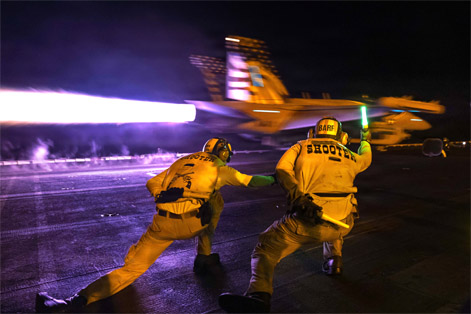
The
strain
goes
beyond
combat
missions.
Troops
stationed
across
the
Middle
East
have
faced
repeated
missile
and
drone
threats,
demanding
air-defense
duties,
long
shifts
and a
persistent
requirement
to
remain
ready
for an
escalation
with
little
warning.
(DOD
photo) |
|
|
U.S.
Troops
Face
Mounting
Fatigue,
Morale
Concerns
as Iran
War
Tests
Military
Readiness
Ashley
Roberts
-
Capitol
Hill
Tell Us
USA News
Network
DETROIT
— Months
of
sustained
operations
connected
to the
war with
Iran are
straining
U.S.
service
members
and
raising
increasingly
urgent
questions
about
whether
the
military
can
maintain
readiness
for
another
major
crisis
without
relief,
replenishment
and
troop
rotations.
Military
leaders
have
privately
voiced
concern
to
Pentagon
and
White
House
officials
about
declining
morale
and
widespread
fatigue
among
personnel
deployed
for
extended
periods
in
support
of the
conflict.
The
Pentagon’s
decision
to
replace
the USS
Abraham
Lincoln
in the
region
reflects
the
pressure
on crews
operating
at a
high
tempo
with no
clear
end date
for the
war.
The
strain
goes
beyond
combat
missions.
Troops
stationed
across
the
Middle
East
have
faced
repeated
missile
and
drone
threats,
demanding
air-defense
duties,
long
shifts
and a
persistent
requirement
to
remain
ready
for an
escalation
with
little
warning.
About
400 U.S.
personnel
had been
wounded
in the
conflict
by early
June,
many
with
traumatic
brain
injuries.
While
most
have
returned
to duty,
the
numbers
underscore
both the
force’s
resilience
and the
pressure
to keep
trained
personnel
available
amid
continuing
operational
demands.
The
readiness
concerns
are not
solely
about
exhausted
personnel.
The war
has
consumed
air-defense
interceptors,
precision-guided
munitions
and
other
equipment
that
would be
essential
in a
future
confrontation
elsewhere.
Rebuilding
depleted
munitions
inventories
could
take
years,
even as
forces
remain
positioned
to
respond
to
renewed
Iranian
attacks.
The
United
States
had
roughly
50,000
service
members
deployed
in and
around
the
Middle
East
during
the
early
phase of
the
conflict.
The size
and
intensity
of the
campaign
put
heavy
demands
on
pilots,
ship
crews,
maintenance
teams,
intelligence
personnel
and
logistics
units
whose
skills
cannot
be
quickly
replaced.
Defense
analysts
caution
that the
issue is
cumulative.
A major
Iran
campaign
layered
on top
of
worldwide
U.S.
commitments
can
expose
weaknesses
in
readiness,
capacity
and the
military’s
ability
to
respond
quickly
to
another
large-scale
crisis.
The
planned
carrier
rotation
offers
some
relief,
but
replacing
a ship
does not
eliminate
the
broader
burden
on
sailors,
air
crews
and
support
units
that
must
continue
operating
in the
region.
For many
troops
and
their
families,
the war
has
meant
prolonged
separation
and
uncertainty
under
conditions
that
fall
short of
full-scale
combat
but
remain
far from
peace.
Pentagon
officials
maintain
that the
force
remains
capable
and
prepared.
Still,
the
combination
of troop
fatigue,
morale
concerns,
combat
injuries
and
depleted
weapons
stocks
presents
a
difficult
reality:
U.S.
military
power
remains
formidable,
but its
margin
for
another
major
conflict
may be
narrower
after
months
of war
with
Iran.
|
|
|
|
|
|
|
|
|




 I
HI TECH NEWS
I
SPORTS
I
I
HI TECH NEWS
I
SPORTS
I