|
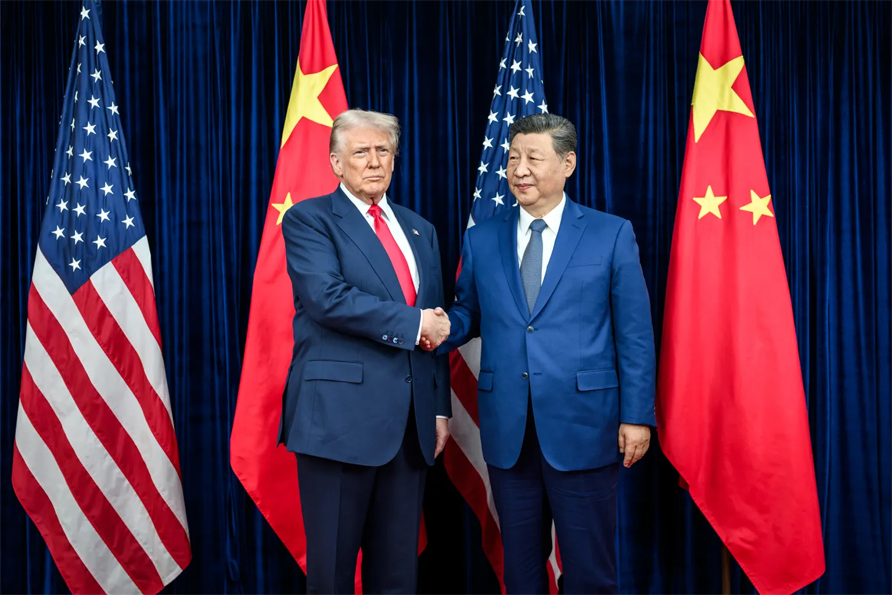
Donald
Trump
and
Chinese
President
Xi
Jinping
share a
handshake
before a
backdrop
of
American
and
Chinese
flags,
signaling
a
high-stakes
meeting
between
the
world's
two
largest
economies. |
|
|
|
|
|
 |
 |
 |
|
|
|
|
|
|
|
|
|
|
| |
48-Hour
of
Tensions:
The Iran
Conflict,
Domestic
Pressures,
and a
Weakened
Negotiating
Hand
Patricia
Romero -
International
-
Politics
Tell Us
USA News
Network
BEIJING
-
President
Donald
Trump
arrived
at
Beijing
Capital
International
Airport
Wednesday
evening,
kicking
off a
high-stakes,
48-hour
summit
with
Chinese
President
Xi
Jinping.
This
marks
the
first
visit by
a
sitting
U.S.
president
to China
in
nearly a
decade,
occurring
at a
moment
of
intense
geopolitical
friction
and
economic
maneuvering.
The
summit,
originally
scheduled
for
March,
was
postponed
by six
weeks
due to
the
escalating
conflict
between
the U.S.
and
Iran.
While
the red
carpet
treatment
reminiscent
of
Trump’s
2017
visit is
expected—including
a tour
of the
Temple
of
Heaven
and a
state
banquet—the
atmosphere
is
markedly
different
as both
leaders
navigate
domestic
and
international
pressures.
Underscoring
the
focus on
trade
and
technology,
a
delegation
of
prominent
U.S.
CEOs
accompanied
the
President
on Air
Force
One.
Notable
figures
include
Elon
Musk,
Tim
Cook,
and
Jensen
Huang,
who
reportedly
joined
at the
last
minute
following
a direct
request
from the
White
House.
Their
presence
signals
a push
to
address
semiconductor
export
restrictions
and the
growing
role of
artificial
intelligence
in the
bilateral
relationship.
A
Weakened
Negotiating
Hand
Analysts
suggest
that
President
Trump is
entering
the
talks
with a
limited
negotiating
hand,
owing to
several
overlapping
domestic
and
international
crises
that
have
eroded
traditional
U.S.
leverage.
The
ongoing
war with
Iran has
disrupted
global
energy
markets
and led
to the
closure
of the
Strait
of
Hormuz,
a
critical
waterway
for oil
transit.
With the
U.S.
Navy
currently
blockading
the
strait
and
intercepting
tankers,
Washington
is
increasingly
reliant
on China
to use
its
economic
leverage
over
Tehran
to help
broker
an end
to
hostilities.
This
dependence
on
Beijing
as a
diplomatic
intermediary
has
significantly
shifted
the
traditional
power
balance
of the
summit.
Compounding
this,
domestic
legal
setbacks
have
stripped
the
administration
of its
most
frequent
tool for
leverage:
tariffs.
A
Supreme
Court
ruling
in
February
2026
held
that the
International
Emergency
Economic
Powers
Act did
not
authorize
the
president
to
impose
sweeping
tariffs.
Subsequent
court
decisions
have
struck
down
replacement
levies,
effectively
removing
the
threat
of
immediate
economic
escalation
from the
negotiating
table.
The
timing
of the
visit
also
coincides
with the
lead-up
to the
November
2026
U.S.
midterm
elections.
The
administration
is
reportedly
eager to
secure a
deal
that can
be
presented
as a
victory
to
voters—specifically
regarding
Chinese
commitments
to
purchase
U.S.
agricultural
goods.
Beijing
is
acutely
aware of
this
political
urgency
and may
use it
to
extract
concessions
on
long-standing
issues.
The
Three
Critical
Pillars
The
meetings,
primarily
centered
at the
Great
Hall of
the
People,
are
expected
to
revolve
around
three
core
areas of
contention:
Trade
and
Tariffs.
Both
sides
are
weighing
potential
cuts to
roughly
$30
billion
in
imports.
Discussions
will
focus on
extending
the
one-year
tariff
truce
reached
in South
Korea
last
October,
as China
seeks
relief
from
levies
that
have
reached
as high
as 145
percent
on
certain
goods.
China
also
holds
confidence
in its
control
over
critical
mineral
supply
chains,
which
are
essential
for
Western
military
rearmament,
giving
Beijing
additional
bargaining
leverage.
The Iran
Conflict.
With the
U.S.
currently
engaged
in
hostilities
in the
Middle
East and
the
Strait
of
Hormuz
remaining
a
flashpoint,
China—a
major
buyer of
Iranian
oil—is
eager to
ensure
stable
energy
flows.
Trump
has
sought
assurances
from Xi
that
Beijing
will not
supply
weapons
to
Tehran,
while
simultaneously
needing
Chinese
cooperation
to help
end the
conflict.
Taiwan.
Tensions
remain
elevated
over
U.S.
arms
sales. A
proposed
$14
billion
weapons
package
currently
awaits
Trump’s
approval—a
move
Beijing
has
vehemently
opposed
and is
expected
to raise
as a key
condition
for
broader
concessions.
Outlook
While
the
White
House
emphasizes
results
over
symbols,
many
analysts
believe
the
summit
is more
about
establishing
a veneer
of
stability
than
achieving
structural
economic
reform.
China
enters
the
talks
feeling
confident,
and both
sides
are
expected
to
maintain
the
appearance
of
cooperation
while
engaging
in
tactical
maneuvering
beneath
the
surface.
Following
one-on-one
talks on
Thursday,
the two
leaders
will
conclude
with a
working
lunch on
Friday
before
the U.S.
delegation
departs
for
Washington.
As the
summit
progresses,
the
central
question
remains
whether
the two
sides
will
extend
the
fragile
trade
truce
agreed
upon in
October,
or
whether
the
current
geopolitical
tensions
will
force a
more
significant—and
potentially
destabilizing—shift
in the
bilateral
relationship.
|
|
|
|
|
|
|
|
|

 I
HI TECH NEWS
I
SPORTS
I
I
HI TECH NEWS
I
SPORTS
I