|
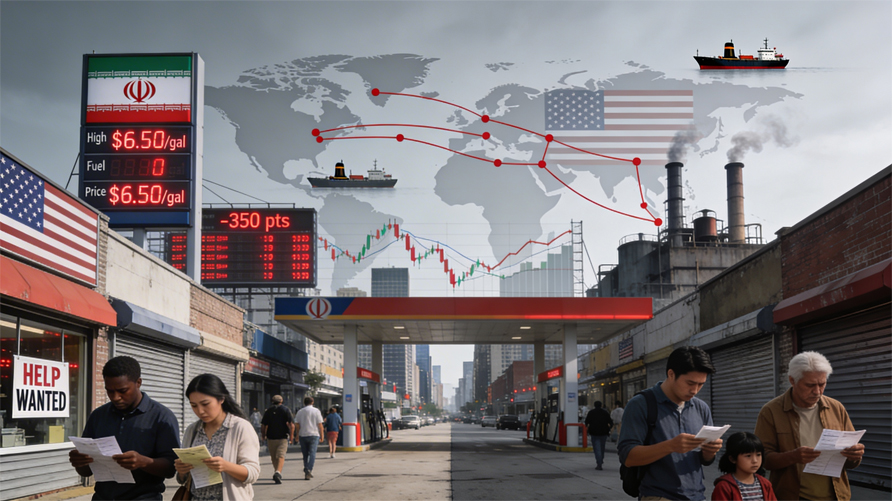
Back in
the
United
States,
the
consequences
are
landing
with
bruising
speed on
ordinary
households
—
precisely
the
constituency
President
Trump
has
staked
his
political
identity
on
protecting.
The
national
average
for a
gallon
of
regular
gasoline
jumped
14% in a
single
week to
$3.41,
from
under $3
just
days
earlier.
The
March 2
increase
was the
largest
single-day
price
rise
since
the
outset
of the
Russia-Ukraine
war in
2022. |
|
|
|
|
|
 |
 |
 |
|
|
|
|
|
|
|
|
|
|
| |
Black
Gold and
Red
Lines:
How the
War on
Iran Is
Reshaping
the
American
Economy
Daoud
Al-Jaber
| Middle
East
Affairs
Analysis
Tell Us
Worldwide
News
Network
WASHINGTON
/ DUBAI
— Those
of us
who have
spent
careers
watching
the
Persian
Gulf
understand
one
immutable
truth:
when
fire
touches
this
region,
the
whole
world
pays at
the
pump.
The war
that
began
ten days
ago —
with
joint
US-Israeli
airstrikes
descending
on
Tehran
in the
pre-dawn
darkness
of
February
28 — is
now
delivering
on that
ancient
promise
with
textbook
precision,
and
Americans
are only
beginning
to grasp
the full
weight
of what
has been
set in
motion.
The
operation
Washington
has
codenamed
"Operation
Epic
Fury"
opened
with the
assassination
of
Supreme
Leader
Ali
Khamenei
and the
systematic
targeting
of
Iranian
military
infrastructure.
It was,
by any
measure,
an
audacious
strike.
But
audacity
has a
price —
and in
this
part of
the
world,
it is
almost
always
denominated
in
barrels.
The
Strait:
The
World's
Most
Dangerous
Chokepoint
To
understand
what is
happening
to
global
energy
markets,
one must
first
look at
a narrow
ribbon
of water
separating
the
Omani
coastline
from the
Iranian
shore. A
fifth of
the
world's
oil
passes
through
the
Strait
of
Hormuz.
Iran has
spent
decades
quietly
preparing
for the
day it
might
need to
weaponize
that
fact.
That day
has
arrived.
The
conflict
has
disrupted
approximately
20% of
global
oil
supplies
transiting
the
Strait,
causing
Brent
crude to
rise
from
around
$70 to
over
$110 per
barrel
within
days. On
Sunday,
it went
further
— Brent
crude
rose by
more
than
30%, at
one
point
topping
$119 a
barrel,
the
first
time oil
surpassed
$100 per
barrel
since
Russia's
invasion
of
Ukraine
in 2022.
Iran's
retaliation
has been
characteristically
asymmetric
and
strategically
calibrated.
Rather
than
engaging
in a
conventional
military
confrontation
it
cannot
win,
Tehran
has
reached
outward
—
striking
at the
architecture
of Gulf
energy
production
itself.
Iranian
forces
struck a
major
refinery
in Saudi
Arabia
and a
liquefied
natural
gas
facility
in
Qatar,
taking
roughly
20% of
the
world's
LNG
supply
offline.
The
message
from
Tehran
to
Washington
and its
Gulf
partners
was
unambiguous:
if we
burn, we
are not
burning
alone.
Qatar's
energy
minister,
whose
country
supplies
Europe
and Asia
with an
irreplaceable
share of
their
natural
gas,
offered
perhaps
the
starkest
warning
of the
week,
stating
simply:
"This
will
bring
down the
economies
of the
world."
That is
not
rhetoric.
That is
a man
watching
his
country's
infrastructure
smolder
and
doing
the
arithmetic.
The
American
Consumer
Pays the
Bill
Back in
the
United
States,
the
consequences
are
landing
with
bruising
speed on
ordinary
households
—
precisely
the
constituency
President
Trump
has
staked
his
political
identity
on
protecting.
The
national
average
for a
gallon
of
regular
gasoline
jumped
14% in a
single
week to
$3.41,
from
under $3
just
days
earlier.
The
March 2
increase
was the
largest
single-day
price
rise
since
the
outset
of the
Russia-Ukraine
war in
2022.
Diesel —
the fuel
that
moves
America's
goods —
tells an
even
sharper
story.
Diesel
was
selling
for
$4.51 a
gallon
on
Saturday,
up
roughly
75 cents
from the
week
prior.
This
matters
enormously
because
diesel
costs
are
embedded
in the
price of
virtually
everything
that
travels
by truck
— which
is to
say,
nearly
everything
Americans
buy.
The
irony is
almost
theatrical.
In his
State of
the
Union
address
just
weeks
ago,
Trump
boasted
that
gasoline
was
below
$2.30 a
gallon
in most
states,
calling
it "the
lowest
in four
years,
and
falling
fast."
Those
gains
have now
been
wiped
out. The
golden
age, it
appears,
has a
very
particular
vulnerability
to
events
in the
Persian
Gulf.
The
Macroeconomic
Threat:
Stagflation's
Shadow
For
economists,
the
deeper
concern
is not
the
price
spike
itself
but what
it
portends
for an
economy
already
carrying
significant
fragility
into
this
conflict.
Before
the war
broke
out, the
US
economy
had
grown at
a tepid
annualized
pace of
just
1.4% in
the
final
quarter
of 2025
— a
sharp
deceleration
from
4.4%
growth
the
quarter
before.
Inflation,
as
measured
by the
Federal
Reserve's
preferred
gauge,
had been
stuck at
approximately
3% for
nearly a
year —
still
above
the
central
bank's
2%
target
even as
gas
prices
fell
through
2025.
The war
has now
upended
the
careful
calculation
the Fed
had been
navigating.
Former
Fed
Chair
Janet
Yellen
warned
that the
conflict
risks
both
higher
inflation
and
slower
growth,
and puts
the Fed
"even
more on
hold,
more
reluctant
to cut
rates
than
they
were
before
this
happened."
Expectations
of two
or three
rate
cuts in
2026 — a
constructive
backdrop
for
investment
and
housing
— are
now in
jeopardy.
The IMF
has
estimated
that
every
sustained
10% rise
in oil
prices
produces
a 0.4%
rise in
inflation
and a
0.15%
reduction
in
global
economic
growth.
Apply
that
formula
to price
increases
already
exceeding
30% at
the
crude
level,
and the
arithmetic
becomes
uncomfortable.
The
specter
hovering
over
this
moment
is one
that
Washington
last
encountered
in the
late
1970s:
stagflation
— the
toxic
combination
of
stagnant
growth
and
surging
prices
that the
1979
Iranian
Revolution
helped
trigger.
That
crisis
brought
about a
spike in
oil
prices
that
became
an
important
contributing
factor
to the
United
States
and
Europe
experiencing
stagflation,
ultimately
requiring
brutal
monetary
tightening
and a
deep
recession
to
resolve.
The
situation
is not
identical.
The US
economy
is less
energy-intensive
than it
was
then,
and
domestic
shale
production
provides
a buffer
that did
not
exist in
1979.
But
those
are
cushions,
not
shields.
Markets
in
Motion
Wall
Street's
reaction
has been
swift
and
revealing.
The Dow
Jones
fell
over 400
points
and the
S&P 500
dropped
0.7% on
March 2.
Gold
prices
rose as
a
safe-haven
asset,
while
airline
stocks
such as
United
Airlines
dropped
6%.
Across
the
Pacific,
Japan's
Nikkei
225 fell
more
than 5%,
South
Korea's
KOSPI
dropped
6%, and
European
indices
opened
lower,
with
Frankfurt's
DAX down
around
3%.
JPMorgan's
economists
captured
the
structural
danger
with
unusual
candor,
with
analyst
Joseph
Lupton
writing
that a
military
conflict
layered
on top
of the
ongoing
trade
war
could
reignite
concerns
over
global
stability,
warning
that a
nascent
economic
recovery
is now
squarely
at risk.
The
Political
Trap
There is
a
dimension
to this
crisis
that
extends
beyond
spreadsheets
— one
that any
student
of
American
political
economy
will
recognize
immediately.
Trump
campaigned
on cost
of
living.
He won
on cost
of
living.
And now
the
defining
metric
of his
presidency
— the
price
Americans
pay to
fill
their
gas
tanks —
is
moving
in the
wrong
direction,
driven
by a war
his
administration
chose to
start.
A CNN
poll
released
on March
2 found
that
nearly
60% of
those
surveyed
disapproved
of US
military
action
in Iran,
while a
Fox News
poll
found
that 61%
of
voters
disapproved
of
Trump's
handling
of the
economy.
Those
numbers,
if
sustained
or
worsened
by
prolonged
conflict,
represent
a
profound
political
liability
heading
into the
2026
midterms.
The Road
Ahead
The
honest
assessment,
after a
decade
of
watching
this
region,
is that
the
economic
consequences
will be
determined
by two
variables
over
which
Washington
has
imperfect
control:
the
duration
of the
conflict,
and the
extent
to which
Iran
succeeds
in
broader
regional
escalation.
In a
worst-case
scenario,
analysts
warn
that oil
prices
remaining
above
$100 per
barrel
could
push
European
inflation
up by
more
than 2
percentage
points
and send
many
economies
into
recession.
Qatar's
energy
minister
has
warned
that all
regional
producers
could
soon be
forced
to halt
production
and that
prices
could
reach
$150 a
barrel.
Even the
more
optimistic
camp
acknowledges
significant
headwinds:
if oil
prices
climb
toward
$100 and
remain
elevated
throughout
2026,
inflation
could
run
roughly
one
percentage
point
higher
than
pre-conflict
forecasts,
with GDP
growth
0.25 to
0.4
percentage
points
lower.
The
Strait
of
Hormuz
has
always
been the
jugular
of the
global
energy
system.
Washington
has now
staked
its
economic
fortunes
— and
its
political
future —
on the
assumption
that it
can
control
what
happens
in those
waters.
History,
and the
geography
of this
ancient
region,
suggests
that
assumption
deserves
the most
serious
scrutiny.
Daoud Al-Jaber is a senior analyst covering
Middle
East
affairs
and Gulf
energy
politics
for Tell
Us
Worldwide
News
Network.
He has
reported
from
Beirut,
Baghdad,
Riyadh,
and
Tehran
over a
career
spanning
more
than two
decades.
|
|
|
|
|
|
|
|
|

 I
HI TECH NEWS
I
SPORTS
I
I
HI TECH NEWS
I
SPORTS
I