|
|
|
|
|
|
 |
|
|
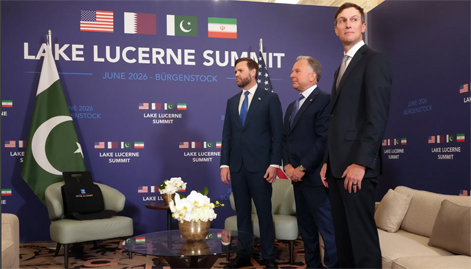
Led by
U.S.
Vice
President
JD Vance
and
senior
Iranian
officials,
the
quadrilateral
summit—mediated
by
Pakistan
and
Qatar—aims
to
salvage
and
expand a
highly
fragile
interim
Memorandum
of
Understanding
(MoU)
signed
earlier
this
month.
|
| |
Iran, US
Advance
Talks in
Switzerland
as
Israel-Hezbollah
Fighting
Complicates
Deal
Daoud
Al-Jaber
- Middle
East
Affairs
Analysis
Tell Us
Worldwide
News
Network
BURGENSTOCK,
Switzerland
—
High-stakes
diplomatic
talks
between
the
United
States
and Iran
have
officially
resumed
at the
Bürgenstock
Resort
in
Switzerland,
operating
under a
dense
cloud of
regional
instability.
Led by
U.S.
Vice
President
JD Vance
and
senior
Iranian
officials,
the
quadrilateral
summit—mediated
by
Pakistan
and
Qatar—aims
to
salvage
and
expand a
highly
fragile
interim
Memorandum
of
Understanding
(MoU)
signed
earlier
this
month.
The
negotiations
are
moving
forward
under
extreme
pressure,
heavily
complicated
by
continuous
military
friction
between
Israel
and
Hezbollah
in
southern
Lebanon,
alongside
economic
Brinkmanship
in the
Persian
Gulf.
The
Lebanon
Leverage
Point
The
primary
bottleneck
in the
current
round of
talks
stems
from how
both
nations
sequence
the
implementation
of the
interim
MoU. The
first
clause
of the
agreement
mandates
a
"ceasefire
on all
fronts."
However,
Washington
and
Tehran
remain
sharply
divided
on its
scope
regarding
the
Israel-Hezbollah
conflict:
• Iran’s
Position:
Tehran
is
strictly
tying
progress
on
nuclear
concessions
to the
situation
in
Lebanon.
Iranian
negotiators
are
using
the
clause
to
demand
that the
U.S.
compel
Israel
to halt
all
military
operations
against
Hezbollah
and
entirely
withdraw
its
forces
from
Lebanese
territory.
• The
U.S.
Dilemma:
The
Biden-Trump
transitional
political
landscape
faces
intense
domestic
pressure.
While
the U.S.
is
pushing
for
regional
de-escalation
to
protect
global
markets,
Israel
is not a
direct
party to
these
Swiss
talks.
• The
Reality
on the
Ground:
A
fragile,
newly
brokered
Israel-Hezbollah
ceasefire
on June
19
brought
a
temporary
pause to
major
airstrikes,
but
tensions
remain
combustible.
Israeli
Prime
Minister
Benjamin
Netanyahu
announced
that the
Israel
Defense
Forces
(IDF)
will
remain
stationed
in their
newly
declared
"security
zone" in
southern
Lebanon
indefinitely
to
protect
its
northern
border,
directly
clashing
with
Iran's
demands
for
total
withdrawal.
The
Strait
of
Hormuz
and
Economic
Stakes
Compounding
the
diplomatic
friction
is the
volatile
situation
in
global
energy
corridors.
Over the
weekend,
the
Islamic
Revolutionary
Guard
Corps
(IRGC)
Navy
announced
the
"closure"
of the
Strait
of
Hormuz,
citing
what it
called a
U.S.
breach
of
commitments
to end
the
regional
war.
U.S.
Central
Command
(CENTCOM)
quickly
disputed
the
total
closure,
noting
that
merchant
ships
are
still
utilizing
alternative
Omani
coastal
lanes
and
heavily
monitored
traffic
schemes.
However,
the move
has
already
injected
sharp
volatility
into
global
oil
prices.
Analysts
view the
shipping
disruptions
as
explicit
leverage
by
Tehran.
By
threatening
the
crucial
economic
artery,
Iran
seeks to
force
early
access
to
sanctions
relief—including
the
release
of
approximately
$12
billion
in
frozen
assets
and U.S.
port
blockade
liftoffs—before
committing
to
technical
talks
regarding
its
highly
enriched
uranium
stockpile.
What's
Next
Technical
and
expert-level
working
groups
have
been
established
in
Switzerland
to
address
these
intersecting
issues.
The
initial
framework
gives
both
sides a
60-day
window
to
hammer
out a
permanent
nuclear
understanding.
However,
with
U.S.
defense
costs
for
regional
operations
climbing
past $29
billion
this
year and
domestic
political
fractures
showing
within
Iran's
regime
over
whether
to
compromise,
the path
forward
remains
remarkably
narrow.
Western
diplomats
close to
the
talks
emphasize
that if
the
local
ceasefire
between
Israel
and
Hezbollah
collapses,
the
Swiss
summit
will
likely
disintegrate
with it.
|
|
|
|
|
|
|
|
|




 I
HI TECH NEWS
I
SPORTS
I
I
HI TECH NEWS
I
SPORTS
I