|
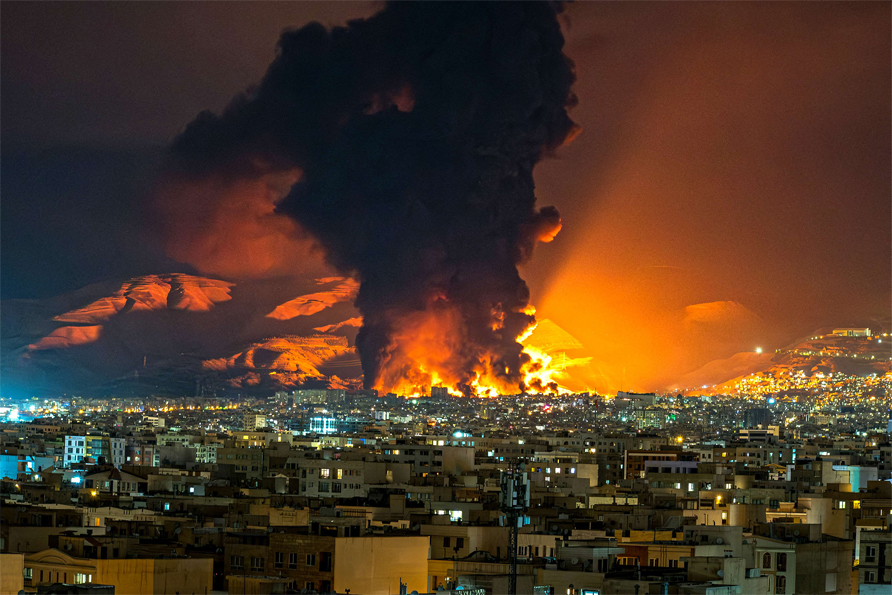
Smoke
and
flames
rise at
the site
of
airstrikes
on an
oil
depot in
Tehran
on
Saturday.
Sasan /
Middle
East
Images /
AFP via
Getty
Images |
|
|
|
|
|
 |
 |
 |
|
|
|
|
|
|
|
|
|
|
| |
Iran War
Escalates
Amid
Regional
Battles
and
Global
Economic
Fears
Missile
Barrages,
Ground
Offensives
Mark
Turning
Point in
Iran
Conflict
Daoud
Al-Jaber
- Middle
East
Affairs
Analysis
Tell Us
Worldwide
News
Network
WASHINGTON/TEHRAN
- Iran
is
locked
in a
fast-escalating
regional
war with
the
United
States
and
Israel
that has
killed
thousands,
disrupted
global
trade
and
drawn in
allied
armed
groups
across
the
Middle
East.
The
month-old
conflict
has
triggered
almost
daily
missile
and
drone
exchanges,
widened
battles
in
Lebanon
and
pushed
oil
prices
sharply
higher
as
fighting
threatens
a vital
energy
chokepoint.
The
current
phase of
the war
began on
February
28, when
US and
Israeli
forces
launched
a
massive
air and
missile
campaign
that
killed
Iran’s
Supreme
Leader
Ali
Khamenei
and
struck
key
military
and
security
sites
across
the
country.
Iran
retaliated
with
large
salvos
of
missiles
and
drones
targeting
Israel
and US
bases
across
the
region,
causing
deaths
and
damage
in
Israeli
cities
and
prompting
mass
evacuations
from
border
areas.
Israeli
officials
say they
have
carried
out
waves of
follow-up
strikes
against
missile
systems,
weapons
plants
and
senior
Iranian
commanders,
including
the
reported
killing
of a top
Revolutionary
Guard
naval
officer,
even as
Iran
continues
to
launch
attacks.
Analysts
and
military
officials
on all
sides
warn the
tempo of
strikes
is
likely
to
continue
for
days, if
not
weeks.
The war
has
quickly
spilled
beyond
Iran and
Israel’s
borders.
In
Lebanon,
Hezbollah
has
intensified
rocket
and
missile
fire
into
northern
and
central
Israel,
prompting
Israel
to
expand
airstrikes
and
ground
operations
aimed at
pushing
the
Iran-backed
group
away
from the
frontier.
Israeli
forces
say they
have
destroyed
large
parts of
Hezbollah’s
arsenal
and
infrastructure,
but the
group
continues
to
launch
barrages,
and
civilian
areas on
both
sides of
the
border
have
been
emptied
under
evacuation
orders.
US
officials
say
Iran-aligned
militias
in Iraq,
Syria
and
Yemen
have
also
stepped
up
attacks
on
American
positions
and Red
Sea
shipping,
underscoring
the
regional
reach of
the
confrontation.
Diplomatic
efforts
to halt
the
fighting
have
faltered
as
positions
harden
in
Tehran,
Washington
and
Jerusalem.
President
Donald
Trump
has
publicly
warned
that US
forces
will
keep
striking
Iranian
targets
unless
Tehran
abandons
its
nuclear
ambitions
and
stops
arming
proxy
groups,
while
also
saying
he will
refrain
from
hitting
Iran’s
energy
facilities
for now.
Iranian
leaders,
for
their
part,
are
moving
to
formalize
control
over the
Strait
of
Hormuz
and are
demanding
an end
to
Israeli
operations
in
Lebanon
and
guarantees
against
future
strikes
on
Iranian
soil
before
considering
a
ceasefire.
Israel’s
government
says it
intends
to keep
up its
campaign
in both
Iran and
Lebanon,
and has
floated
the idea
of a
long-term
security
zone in
southern
Lebanon.
The
conflict
is
already
rippling
through
the
global
economy.
Oil
prices
have
climbed
as
shipping
through
the
Strait
of
Hormuz
and
other
key
routes
has been
curtailed,
contributing
to sharp
drops in
US and
global
stock
markets.
Economists
warn
that a
prolonged
disruption
could
become
the
worst
trade
shock in
decades,
raising
energy
costs
for
consumers
and
complicating
efforts
to tame
inflation
in major
economies.
With
missiles
still
flying,
civilians
displaced
and
armies
on the
move,
diplomats
caution
that the
window
for an
early
ceasefire
is
narrowing,
and that
any
miscalculation
could
tip an
already
volatile
region
into an
even
wider
war.
|
|
|
|
|
|
|
|
|

 I
HI TECH NEWS
I
SPORTS
I
I
HI TECH NEWS
I
SPORTS
I