|
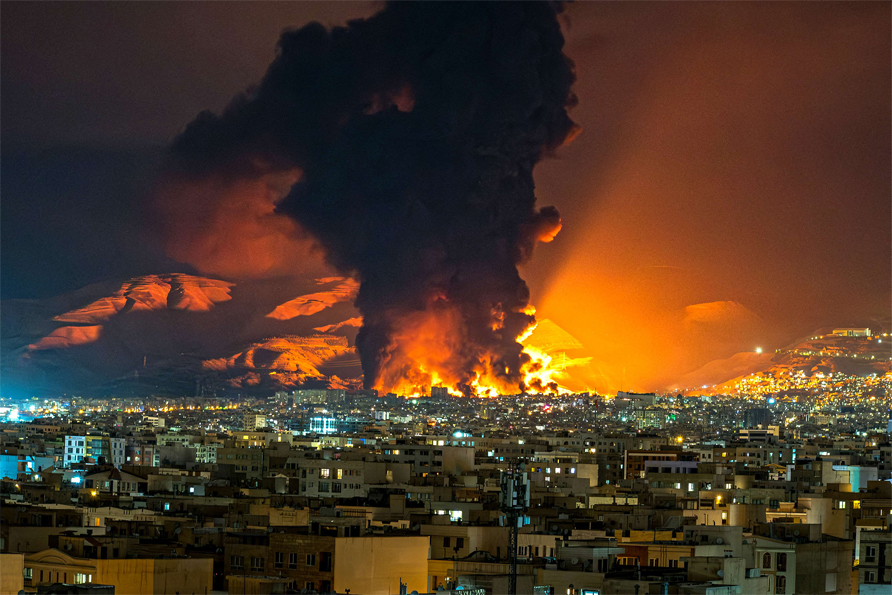
Smoke
and
flames
rise at
the site
of
airstrikes
on an
oil
depot in
Tehran
on
Saturday.
Sasan /
Middle
East
Images /
AFP via
Getty
Images |
|
|
|
|
|
 |
 |
 |
|
|
|
|
|
|
|
|
|
|
| |
No
Winners,
No Exit:
Both
Sides
Can
Inflict
Pain,
Neither
Can Win
Daoud
Al-Jaber
- Middle
East
Affairs
Analysis
Tell Us
Worldwide
News
Network
TEL
AVIV -
Israeli
and
American
planners
entered
this
week
facing a
reality
they
long
gamed
out on
paper
but
hoped
never to
fight
for
real: a
multi‑front
war
against
Iran and
its
network
of
proxies,
stretching
from the
Mediterranean
to the
Strait
of
Hormuz,
with no
clean
off‑ramp
in
sight.
The
battlefield
looks
chaotic,
but from
Tehran
to Tel
Aviv,
each
actor is
moving
along
patterns
that are
grimly
familiar
to
anyone
who has
watched
this
region
burn
over the
last two
decades.
In Iran,
the
leadership
is
leaning
hard
into a
narrative
of
imposed
war and
national
survival,
using
sustained
missile
and
drone
strikes
to show
it can
still
reach
Israeli
and Gulf
targets
despite
heavy
bombardment
of its
military
infrastructure.
That is
classic
deterrence-through-punishment
doctrine:
absorb
the
first
blow,
then
prove
you can
still
raise
the cost
for your
enemies.
For
Israel
and the
United
States,
the goal
is the
inverse
–
degrade
enough
of
Iran’s
launch
capability,
air
defenses
and
command
nodes
that the
next
wave of
attacks
is
smaller,
less
accurate
and less
politically
useful
to
Tehran.
Neither
side can
actually
achieve
its
maximal
aim;
both can
inflict
significant
pain
while
they
try.
The
escalation
at sea
is just
as
revealing.
Iran’s
disruption
of
traffic
through
the
Strait
of
Hormuz
is not a
surprise;
it is
the
scenario
war-gamed
in every
Western
capital
for
years.
What
matters
is that
it has
finally
moved
from
exercise
slide
decks to
reality,
forcing
Washington
and its
allies
into a
naval
posture
that
mixes
coercion
and
vulnerability.
Dispatching
warships
to keep
the
strait
open
does
restore
some
confidence
to
energy
markets,
but it
also
places
high‑value
targets
within
range of
Iranian
missiles,
drones
and
fast-boat
swarms.
This is
deterrence
by
entanglement:
Iran
exploits
the fact
that no
US
president
wants to
explain
a sunk
destroyer
on the
evening
news.
Meanwhile,
Gaza and
the West
Bank
have
slipped
into a
dangerous
blind
spot.
With
global
focus
fixed on
the Iran
front,
Israeli
operations
in the
Palestinian
territories
continue
with
even
less
outside
scrutiny
than
usual.
For
militant
factions,
the
wider
war is a
strategic
windfall
– proof
that
“resistance”
can draw
in
bigger
players
and
stretch
Israel’s
bandwidth.
For
civilians,
it means
the
worst of
both
worlds:
tightened
closures,
dwindling
aid, and
the
knowledge
that
their
suffering
is now
just one
facet of
a much
larger
war
narrative.
That is
exactly
how long
wars
entrench
grievances
that
outlive
ceasefires
and
peace
conferences.
From a
terrorism
and
insurgency
lens,
the most
worrying
trend is
not
today’s
missile
count
but
tomorrow’s
recruitment
pool.
Every
strike
on a
fuel
depot in
Iran,
every
family
displaced
in
southern
Lebanon,
every
hospital
pushed
past the
breaking
point in
Gaza
becomes
raw
material
for the
next
generation
of
fighters
and
fundraisers.
The more
this
conflict
normalizes
collective
punishment
and
long‑range
stand‑off
attacks,
the more
space it
creates
for
non‑state
actors
to
present
themselves
as the
only
responsive,
locally
rooted
alternative
to
distant
governments
and
foreign
air
power.
In
practical
terms,
that
means
even a
negotiated
lull in
the
coming
weeks
would
not end
this war
so much
as
freeze
it in
place.
The
architecture
of
escalation
–
hardened
narratives,
expanded
weapons
smuggling
routes,
normalized
missile
exchanges,
naval
brinkmanship
– will
remain.
The
region
has
entered
a phase
where
state
and
non‑state
actors
alike
are
adapting
to
warfare
that is
more
distributed,
more
technological,
and less
constrained
by
borders.
Seasoned
observers
of
terrorism
and
political
violence
have
seen
this
movie
before:
when the
guns
quiet,
the
networks,
grievances
and
clandestine
logistics
keep
running
in the
background,
patiently
setting
the
stage
for the
sequel.
|
|
|
|
|
|
|
|
|

 I
HI TECH NEWS
I
SPORTS
I
I
HI TECH NEWS
I
SPORTS
I