|
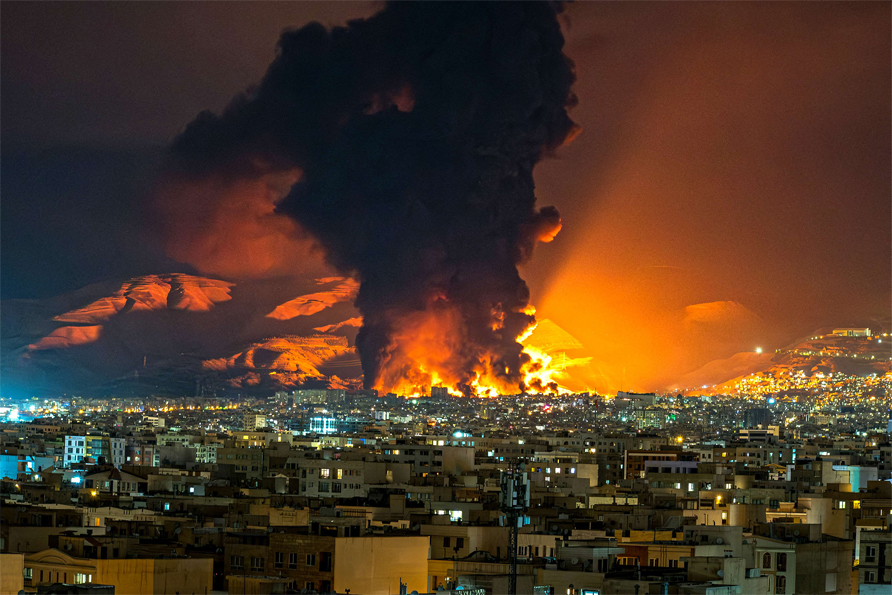
Smoke
and
flames
rise at
the site
of
airstrikes
on an
oil
depot in
Tehran
on
Saturday.
Sasan /
Middle
East
Images /
AFP via
Getty
Images |
|
|
|
|
|
 |
 |
 |
|
|
|
|
|
|
|
|
|
|
| |
Special
Report
and
Analysis:
Three
Weeks
In, the
Iran War
Spirals
Beyond
Control
Daoud
Al-Jaber
-
U.S./Middle
East
Affairs
Analysis
Tell Us
Worldwide
News
Network
TEHRAN
and
WASHINGTON
- The
conflict
between
the
United
States,
Israel,
and Iran
entered
its 21st
day on
Friday,
marked
by the
first
combat
strike
on an
American
F-35 and
deepening
divisions
over
military
strategy.
The
aircraft
was
forced
to make
an
emergency
landing
at a
regional
base
after
taking
Iranian
fire;
the
pilot is
in
stable
condition.
Economic
disruptions
intensified
as a
strike
on
Qatar’s
Ras
Laffan
facility
cut 17
percent
of its
LNG
output,
representing
a 9
percent
hit to
the
Qatari
economy
and
threatening
energy
contracts
in
China,
South
Korea,
Italy,
and
Belgium.
While
the
Strait
of
Hormuz
remains
a
primary
flashpoint
for 20
percent
of
global
oil and
half of
the
world's
fertilizer
exports,
the
World
Food
Programme
warns
that 45
million
people
now face
acute
hunger.
Diplomatic
friction
surfaced
as
Israeli
Prime
Minister
Netanyahu
announced
a halt
to
strikes
on
Iranian
energy
infrastructure
following
reported
disagreements
with the
Trump
administration
over the
South
Pars gas
field.
President
Trump
has
since
demanded
NATO
allies
assist
in
securing
the
Strait,
suggesting
a
failure
to do so
would
negatively
impact
the
future
of the
alliance.
Casualties
in Iran
have
reached
1,400
killed
and
18,000
injured,
though a
21-day
national
internet
blackout
continues
to
obscure
the full
scale of
the
crisis.
Despite
the
initial
decapitation
strikes
intended
to
collapse
the
government,
Iranian
forces
appear
to be
adapting
by
rationing
missile
stockpiles.
Reports
from
Omani
mediators
indicate
that a
negotiated
nuclear
breakthrough
was
nearly
reached
on
February
27, days
before
the
current
offensive
began.
A brief
chronological
timeline
of
events:
February
27 2026:
Omani
mediators
report a
near-breakthrough
in
indirect
nuclear
negotiations
in
Geneva.
Both
U.S. and
Iranian
officials
describe
the
talks as
constructive
with
potential
for a
final
deal.
February
28 2026:
The
United
States
and
Israel
launch
coordinated
decapitation
strikes
and
aerial
offensives
across
Iran.
The
operation
targets
nuclear
sites,
military
infrastructure,
and
government
leadership.
Supreme
Leader
Ali
Khamenei
is
reported
killed;
his son
is later
named
successor.
March 1
to March
10 2026:
Iran
initiates
retaliatory
strikes
against
U.S.
bases
and
regional
oil
facilities.
The
Strait
of
Hormuz
is
effectively
closed
to
commercial
traffic.
Global
oil
prices
surge
past 115
dollars
per
barrel.
March 11
to March
17 2026:
The
World
Food
Programme
warns
that 45
million
people
face
acute
hunger
due to
the halt
of
fertilizer
and
grain
exports
through
the
Gulf.
Domestic
pressure
mounts
on the
Trump
administration
as U.S.
fuel
prices
spike.
March 18
2026:
Israeli
forces
strike
the
South
Pars gas
field in
Iran. In
response,
Iran
hits
Qatar’s
Ras
Laffan
LNG
facility,
causing
20
billion
dollars
in
projected
annual
losses.
President
Trump
publicly
breaks
with
Israel
on
targeting,
stating
he did
not
approve
the gas
field
strike.
March 19
2026: An
American
F-35
makes an
emergency
landing
after
being
struck
by
Iranian
fire,
the
first
such
combat
damage
in the
platform's
history.
Israeli
Prime
Minister
Netanyahu
agrees
to halt
strikes
on
energy
infrastructure.
March 20
2026:
Conflict
reaches
Day 21.
A
nationwide
internet
blackout
continues
in Iran.
Heavy
airstrikes
are
reported
in
Tehran
during
the
Persian
New Year
as
regional
air
defenses
intercept
missiles
over
Dubai
during
Eid
prayers.
|
|
|
|
|
|
|
|
|

 I
HI TECH NEWS
I
SPORTS
I
I
HI TECH NEWS
I
SPORTS
I