|
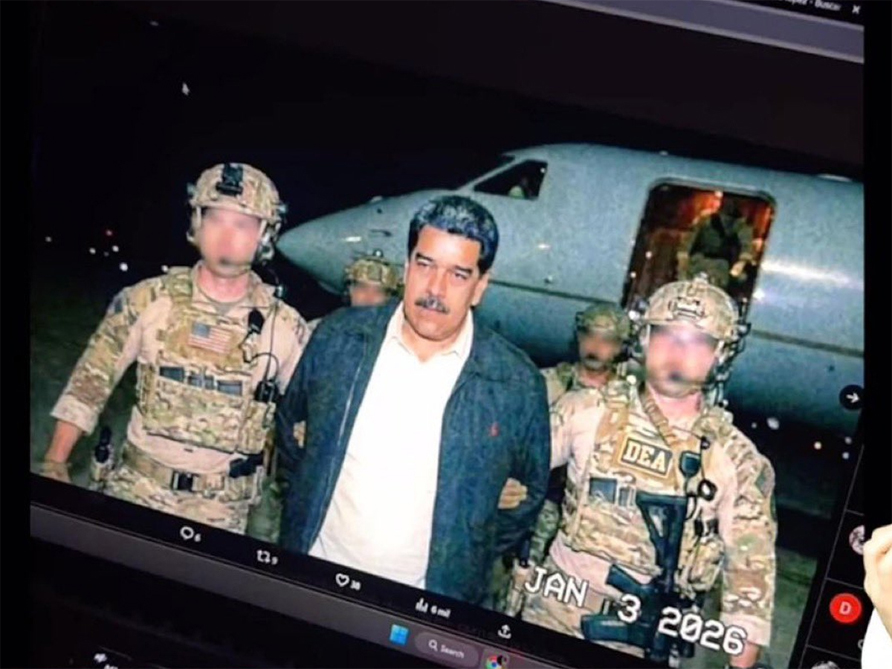
What
emerges
from the
global
response
is
nothing
less
than a
fundamental
reconfiguration
of Latin
American
geopolitics.
For the
first
time in
the
post-Cold
War era,
major
Latin
American
powers
are
openly
opposing
a U.S.
military
operation
in the
region.
(AI
image
generated
by Tell
Us
Worldwide
Media) |
|
|
|
|
|
 |
 |
 |
|
|
|
|
|
|
 |
|
|
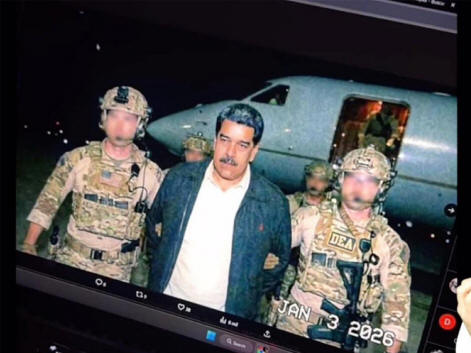
The
image
comes
amid
claims
by
President
Donald
Trump
that
Maduro
and his
wife
were
captured
and
flown
out of
Venezuela.
(Photo:
X/cristobalsoria) |
| |
Washington
Removed
Maduro,
Lost
Latin
America:
What a
Latin
American
Analyst
Sees
Ahead
Elías
Duran
Camhaji
-
Analyst/Latin
American
Affairs
Tell Us
Worldwide
News
CARACAS,
VENEZUELA
- A
Latin
American
Analyst's
Assessment
of
Trump's
Military
Gambit
and
Regional
Upheaval
THE
OPERATION
AND ITS
SIGNIFICANCE
On
Saturday
morning,
the
Trump
administration
executed
what may
be the
most
consequential
military
operation
in the
Western
Hemisphere
since
Panama
1989.
The
capture
of
Nicolás
Maduro
and his
wife,
Cilia
Flores,
through
a
coordinated
strike
involving
all
branches
of the
U.S.
military
marks a
watershed
moment—one
that
fundamentally
challenges
the
regional
order
that has
evolved
over the
past two
decades.
What
we
witnessed
was not
merely a
police
action
or a
targeted
strike.
This was
a
full-scale
occupation
strategy,
implicitly
acknowledged
by
Trump's
declaration
that
Washington
will
"run"
Venezuela
indefinitely
until "a
proper
transition
can take
place"—language
conspicuously
vague
about
both
timeline
and end
conditions.
The
presence
of at
least
7,000
U.S.
military
personnel,
anchored
by the
USS Iwo
Jima,
signals
this is
no brief
intervention.
This is
military
administration
with an
undefined
duration.
The
tactical
competence
of the
operation
is
evident.
Planning
required
months
of
coordination
across
all
service
branches,
meticulous
intelligence
work,
and the
kind of
logistical
sophistication
that
only the
world's
preeminent
military
power
possesses.
General
Dan
Caine's
characterization
of the
operation
as
"brilliant"
was not
mere
hyperbole—from
a purely
military
standpoint,
the
execution
was
flawless.
Yet
military
success
and
strategic
wisdom
are not
synonymous,
a
distinction
that
becomes
increasingly
apparent
as we
examine
the
international
response.
TRUMP'S
STATED
RATIONALE:
THE
PRESS
CONFERENCE
ANALYSIS
The
President's
Mar-a-Lago
press
conference
revealed
several
crucial
aspects
of
Washington's
thinking
and
miscalculations:
The Oil
Dimension:
Trump's
repeated
references
to
controlling
and
selling
Venezuelan
oil
expose
the
economic
motivation
undergirding
this
operation.
This is
not
primarily
about
democracy
promotion
or human
rights—it
is about
energy
resources
and
geopolitical
dominance.
For
anyone
familiar
with
Washington's
historical
interventions
in Latin
America
(1953
Guatemala,
1973
Chile),
this
candor
is both
striking
and
deeply
troubling.
Congressional
Circumvention:
The
administration's
decision
not to
notify
Congress
beforehand,
justified
by
Secretary
Rubio as
necessary
to
prevent
leaks,
represents
a
significant
constitutional
usurpation.
The
preference
for
operational
security
over
legislative
oversight
establishes
a
dangerous
precedent.
Trump's
blunt
statement—"Congress
leaks"—betrays
contempt
for
institutional
checks
and
balances.
This is
oligarchy
masquerading
as
pragmatism.
The
Cuba
Pivot:
Trump's
signaling
that
Cuba
will be
next is
not
rhetorical
flourish
but
strategic
warning.
The
administration
is
clearly
contemplating
a
broader
Latin
American
realignment,
one that
would
reshape
the
region's
political
economy
entirely.
This
represents
a
revival
of early
Cold War
interventionism,
reimagined
for
21st-century
conditions.
The
Maduro
Question:
Trump's
assertion
that he
has been
in
communication
with
Vice
President
Delcy
Rodríguez,
claiming
she
agreed
to
cooperate,
appears
to be
either
disinformation
or a
spectacular
miscalculation.
Rodríguez's
subsequent
televised
address—defiant,
demanding
proof of
Maduro's
whereabouts,
reasserting
his
legitimacy—suggests
the
administration
profoundly
misread
the
situation.
This
is
critical:
even
members
of the
Maduro
regime
are not
capitulating
as
expected.
THE
REGIONAL
RESPONSE:
A
HISTORIC
REALIGNMENT
What
emerges
from the
global
response
is
nothing
less
than a
fundamental
reconfiguration
of Latin
American
geopolitics.
For the
first
time in
the
post-Cold
War era,
major
Latin
American
powers
are
openly
opposing
a U.S.
military
operation
in the
region.
Brazil's
Pivotal
Stance
President
Lula da
Silva's
response
deserves
particular
scrutiny.
His
assertion
that the
strikes
"cross
an
unacceptable
line"
and his
warning
that
attacking
countries
"in
flagrant
violation
of
international
law is
the
first
step
toward a
world of
violence,
chaos,
and
instability,
where
the law
of the
strongest
prevails
over
multilateralism"
represents
a
decisive
break
from
decades
of
Brazilian
compliance
with
U.S.
regional
hegemony.
This is
the
leader
of Latin
America's
largest
economy
and most
influential
nation
explicitly
rejecting
American
military
unilateralism.
This
matters
profoundly.
Brazil
has
historically
sought
equilibrium
between
U.S.
partnership
and
regional
autonomy.
Lula's
choice
to
explicitly
condemn
the
operation
rather
than
maintain
diplomatic
ambiguity
signals
that
Washington
has
crossed
a
threshold
in
Brazilian
calculations
about
regional
order.
The
Colombian
Conundrum
Colombia's
response
is
particularly
revealing
because
it
exposes
the
contradictions
of U.S.
strategy.
Despite
being
Washington's
closest
military
and
strategic
ally in
South
America,
President
Gustavo
Petro
has
condemned
the
operation
as "an
aggression
against
the
sovereignty
of
Venezuela
and
Latin
America."
Petro,
who sits
uncomfortably
between
his
leftist
political
roots
and the
reality
of
Washington's
overwhelming
military
presence
on
Colombian
territory,
had to
publicly
distance
himself
from the
very
power
that
underpins
his
presidency's
security
architecture.
This
is the
trap
Washington
has
created
for
itself:
even its
nominal
allies
must
protect
their
own
legitimacy
by
opposing
naked
interventionism.
The
Ideological
Collapse
of
"Democratic
Solidarity"
Washington
has long
justified
its
Latin
American
interventions
through
the
rhetoric
of
democracy
promotion
and
human
rights.
The
Biden
administration
nominally
supported
Venezuelan
opposition
leaders
like
María
Corina
Machado
and
Edmundo
González,
framing
opposition
to
Maduro
within
democratic
and
humanitarian
frameworks.
Trump
has
discarded
this
language
entirely.
His
administration
has
replaced
democratic
solidarity
with
naked
power
assertion:
we will
control
Venezuela
because
we can;
we will
extract
its oil
because
we can;
we will
move on
to Cuba
next
because
we can.
This
candor,
while
honest
about
American
power,
destroys
the
ideological
legitimacy
that
Washington
has
cultivated
since at
least
the Cold
War's
end.
For
Latin
American
leaders,
this is
actually
clarifying,
if
alarming.
The
pretense
is gone.
This is
about
hegemony,
not
principle.
THE
INTERNATIONAL
LAW
CRISIS
The
international
response
reveals
a
unprecedented
consensus
that
Washington
has
violated
fundamental
principles
of
international
law. The
UN
Secretary-General
expressed
being
"deeply
alarmed,"
Russia
called
it "an
act of
armed
aggression,"
and
China
condemned
it as a
"serious
violation"
of
Venezuela's
sovereignty.
Even
U.S.
allies
have
hedged
their
support
with
caveats
about
international
law.
This
is
extraordinarily
significant.
A
permanent
member
of the
UN
Security
Council
(Russia)
and the
second-largest
economy
globally
(China)
have
unambiguously
accused
Washington
of
military
aggression.
Whatever
the
operational
merits
of the
strike,
the
geopolitical
cost is
enormous.
The
absence
of any
plausible
legal
framework
for this
operation
is
notable.
The U.S.
did not
invoke
self-defense
under
Article
51 of
the UN
Charter,
nor did
it seek
Security
Council
authorization.
The
administration
has
simply
acted,
daring
the
international
community
to
respond.
This is
legal
nihilism
at the
state
level—a
calculation
that
American
military
power
can
impose
outcomes
regardless
of
international
law's
constraints.
THE
OPPOSITION
PROBLEM:
A
NEGLECTED
QUESTION
One
aspect
that
deserves
greater
scrutiny
is what
this
intervention
means
for
Venezuela's
opposition.
María
Corina
Machado
and
Edmundo
González,
the
faces of
democratic
resistance
to
Maduro,
have
notably
remained
silent
or
issued
oblique
responses.
Neither
has
publicly
celebrated
the U.S.
operation,
a
notable
restraint
given
their
years of
opposition.
Why?
Likely
because
they
understand
a
fundamental
reality:
an
opposition
that
comes to
power
through
foreign
military
occupation
faces
severe
legitimacy
deficits.
The
opposition
can
claim
electoral
validity
(González
won the
disputed
July
2024
election),
but
military
occupation
undermines
the very
democratic
credentials
they
have
been
asserting.
How can
one
claim to
represent
the
people's
will
when you
are
installed
by
foreign
troops?
This is
the
paradox
of U.S.
intervention:
it may
remove
the
dictator,
but it
potentially
discredits
the
alternative.
Venezuela's
opposition
faces
the
prospect
of
governing
under
American
military
supervision—hardly
the
democratic
restoration
they
have
envisioned.
HISTORICAL
ECHOES
AND
DIVERGENT
OUTCOMES
The
Panama
1989
comparison
is
instructive
but
potentially
misleading.
Yes, the
operational
similarities
are
striking:
swift
military
action,
removal
of a
dictator,
rapid
establishment
of
control.
But the
contexts
differ
dramatically.
Panama
in 1989
was a
strategically
critical
country
controlling
the
Canal,
with a
relatively
small,
homogeneous
population
of 2.5
million.
The
occupation
could be
brief
because
the
geopolitical
objectives
were
limited
and the
nation
was
manageable
at small
scale.
Venezuela
is an
entirely
different
proposition:
28
million
people,
massive
territorial
expanse,
deeply
fragmented
political
society,
and no
easily
identifiable
post-occupation
political
settlement.
The
Panamanian
opposition
had
coherent
leadership
and
broad
legitimacy.
Venezuela's
opposition
is
fractious,
weakened
by
Maduro's
repression,
and now
implicated
in
foreign
occupation.
The
likelihood
of a
lengthy
American
military
presence
is
extraordinarily
high.
Washington
may have
vastly
underestimated
the
complexity
of
consolidating
control
over a
hostile,
fragmented
nation
of this
scale.
REGIONAL
REALIGNMENT:
THE
STRATEGIC
IMPLICATIONS
What is
emerging
is a
potential
reconfiguration
of Latin
American
alignments
that
will
have
ramifications
for
decades:
The
China-Russia
Card:
Latin
American
nations
dissatisfied
with
Washington's
unilateralism
now have
alternatives.
Chinese
investment,
Russian
military
support,
and
diplomatic
backing
from
both
powers
provide
counterbalances
that did
not
exist
during
the Cold
War.
Brazil,
Colombia,
and
Mexico
are
unlikely
to
formally
ally
with
Beijing
or
Moscow,
but they
can use
the
threat
of such
realignment
to
constrain
Washington's
freedom
of
action.
The
Regional
Powers'
Assertion:
Brazil,
Mexico,
and
Colombia—the
three
major
regional
economies—are
simultaneously
asserting
autonomy
and
asserting
limits.
None can
effectively
oppose
Washington
militarily,
but all
can
undermine
occupation
objectives
through
diplomatic
resistance,
public
opposition,
and
refusal
of
cooperation.
The
Ideological
Shift:
Cuba's
Miguel
Díaz-Canel
calling
the
operation
a
"criminal
US
attack"
and
demanding
an
urgent
international
response
signals
that
Washington's
actions
are
unifying
anti-American
sentiment
across
the
region's
left.
This is
precisely
the
opposite
of what
the
administration
likely
intended.
THE
CUBAN
ESCALATION
SCENARIO
Trump's
transparent
signaling
that
Cuba
will be
next is
not mere
rhetoric.
It
represents
a
fundamental
challenge:
Will
Washington
proceed
with
another
military
intervention?
And if
so, what
are the
cascading
consequences?
A
U.S.
operation
against
Cuba
would
represent
an even
more
dramatic
assertion
of
hegemony
than
Venezuela.
Cuba is
more
ideologically
committed,
more
populous,
more
militarily
prepared,
and
embedded
in
explicit
alliance
with
Russia
and
China.
The
international
blowback
would be
exponentially
greater.
Yet
Trump's
apparent
willingness
to
contemplate
such
action
suggests
he may
believe
that
demonstrating
overwhelming
force in
Venezuela
will
deter
alternatives
and
create
the
space
for
further
intervention.
Alternatively,
he may
simply
be
signaling
resolve
without
intending
action.
Either
way, the
mere
contemplation
of Cuban
intervention
transforms
the
regional
climate.
ASSESSMENT
AND
OUTLOOK
From a
Latin
American
analyst's
perspective,
this
moment
represents
both a
climax
and a
beginning.
The
climax:
the end
of the
fiction
that the
United
States
respects
regional
sovereignty
and
international
law in
the
Americas.
The
beginning:
a
reconfiguration
of how
regional
powers
will
organize
themselves
in
response.
The
operation
succeeded
militarily
and
failed
strategically.
Washington
removed
Maduro
but
energized
regional
opposition,
unified
major
Latin
American
powers
against
American
unilateralism,
and
potentially
set
conditions
for the
kind of
anti-American
realignment
that has
not
existed
since
the Cold
War.
The
fundamental
question
now is
whether
Washington
can
consolidate
political
control
over
Venezuela
while
managing
the
regional
backlash,
or
whether
the
occupation
becomes
a
quagmire
that
exhausts
American
attention
and
resources.
Historical
precedent
suggests
the
latter
is more
likely.
What is
certain:
Latin
America's
post-Cold
War
order—predicated
on
nominal
American
hegemony
within
frameworks
of
international
law and
regional
cooperation—has
ended.
What
replaces
it
remains
to be
determined,
but it
will be
measurably
different
from
what
preceded
it.
|
|
|
|
|
|
|
|
|

 I
HI TECH NEWS
I
SPORTS
I
I
HI TECH NEWS
I
SPORTS
I