|
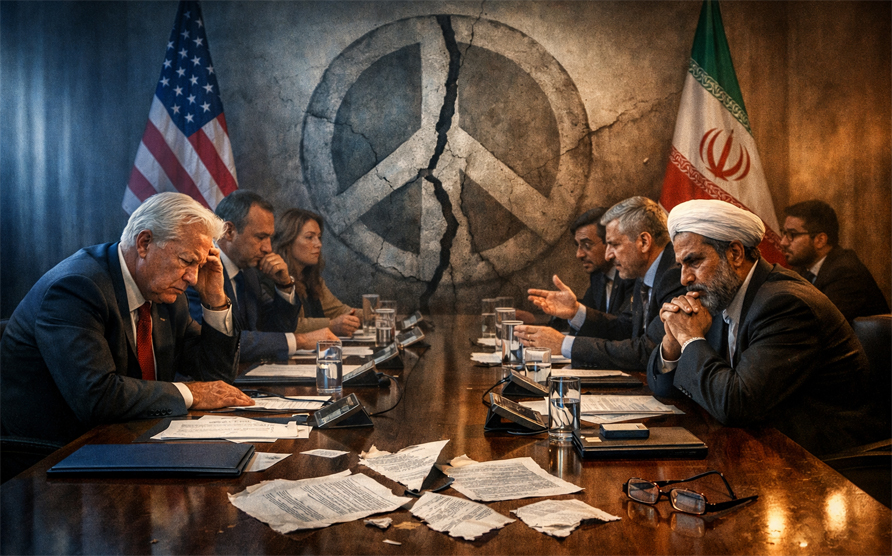
Diplomats
who once
spoke of
possible
“off-ramps”
now
acknowledge
privately
that
none
remain.
(AI
photo
image) |
|
|
|
|
|
 |
 |
 |
|
|
|
|
|
|
|
|
|
|
| |
War
Between
U.S. and
Iran
Grows
More
Dangerous
After
Failed
Talks
Daoud
Al-Jaber
- Middle
East
Affairs
Analysis
Tell Us
Worldwide
News
Network
ABU
DHABI -
The
conflict
between
the
United
States
and Iran
is
entering
a more
dangerous
stage,
with
neither
side
showing
any
willingness
to
compromise.
President
Trump
has
rejected
Iran’s
latest
proposal
as
“totally
unacceptable,”
calling
it a
“piece
of
garbage”
and
saying
the
cease-fire
is “on
life
support.”
Diplomats
who once
spoke of
possible
“off-ramps”
now
acknowledge
privately
that
none
remain.
Washington
sees
Tehran’s
response
as
political
theater,
while
Iranian
officials
say the
U.S. is
demanding
surrender
disguised
as
negotiation.
The
result
is a
widening
conflict
with no
clear
path to
de-escalation.
Military
activity
has
intensified
across
the
region.
U.S. and
Israeli
forces
have
expanded
strikes
deeper
into
Iranian
territory,
targeting
missile
sites,
naval
assets,
and
facilities
Western
intelligence
links to
nuclear
development.
Iran has
responded
with
sustained
drone
and
missile
attacks
on U.S.
positions,
while
allied
militias
in Iraq
and
Lebanon
have
stepped
up their
operations.
Each
round of
attacks
has
grown
more
aggressive,
increasing
the risk
that a
miscalculation
could
quickly
spiral
into a
broader
war.
The
Strait
of
Hormuz—one
of the
world’s
most
critical
energy
routes—is
now
effectively
closed.
Tankers
are
either
halted
or
taking
longer
routes
to avoid
Iranian
waters
following
a series
of
seizures
and
attacks.
Global
energy
markets
are
reacting
as
expected,
with
prices
rising
and
governments
reassessing
their
vulnerability
to
disruptions
in the
region.
Inside
Iran,
the
conflict
is
unfolding
alongside
deep
internal
instability.
Months
of
protests,
a
worsening
economic
crisis,
and a
widespread
security
crackdown
have
left the
country
under
strain.
The
transfer
of power
to
Mojtaba
Khamenei
after
his
father’s
death
has not
brought
stability.
Instead,
Iran’s
leadership
is
leaning
into the
conflict,
framing
it as a
fight
for
national
survival
even as
unrest
continues.
Efforts
to
revive
nuclear
diplomacy
have
stalled
completely.
The U.S.
is
demanding
that
Iran
give up
its
enriched
uranium
stockpile,
while
Tehran
refuses
to
dismantle
what it
sees as
essential
to its
sovereignty.
Trump
has said
Iran
initially
indicated
it might
allow
U.S.
involvement
in
removing
highly
enriched
uranium
but then
backed
away
from
that
position
in its
latest
proposal.
With
both
sides
firmly
entrenched,
the
nuclear
issue is
now
fueling
the
broader
conflict
rather
than
containing
it.
For now,
the war
continues
to build
momentum.
Each day
brings
new
strikes,
statements,
and
warnings,
but no
indication
that
either
side is
prepared
to step
back. As
tensions
spread
across
the
region,
the
conflict
is
becoming
harder
to
contain—and
increasingly
unpredictable.
|
|
|
|
|
|
|
|
|

 I
HI TECH NEWS
I
SPORTS
I
I
HI TECH NEWS
I
SPORTS
I